Explorando el uso del Montreal Cognitive Assessment (MoCA) en centros audiológicos: relación entre rendimiento cognitivo, escolaridad e hipoacusia
DOI:
https://doi.org/10.51445/sja.auditio.vol10.2026.127Palabras clave:
presbiacusia, cognición, MoCA, demencia, audiciónResumen
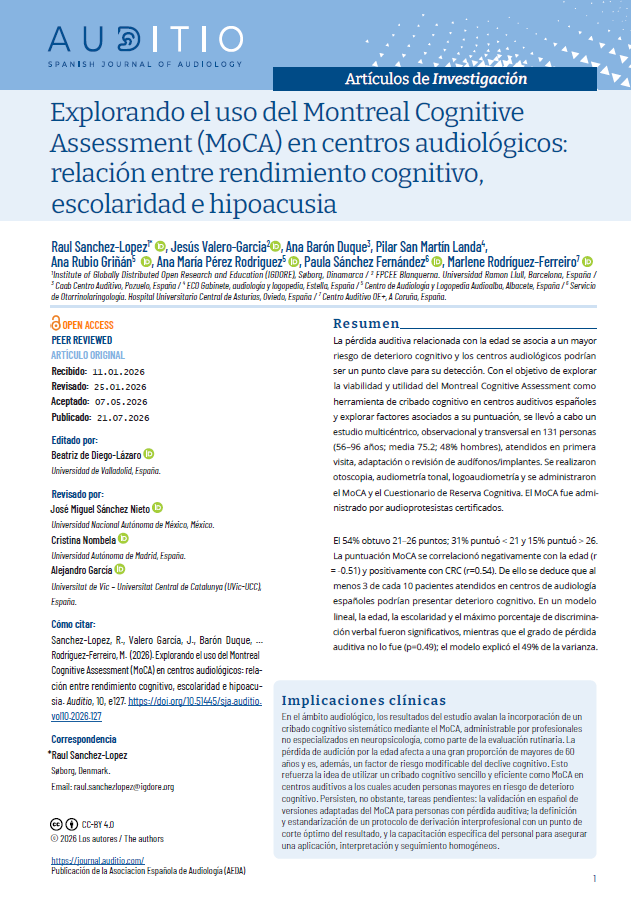
La pérdida auditiva relacionada con la edad se asocia a un mayor riesgo de deterioro cognitivo y los centros audiológicos podrían ser un punto clave para su detección. Con el objetivo de explorar la viabilidad y utilidad del Montreal Cognitive Assessment como herramienta de cribado cognitivo en centros auditivos españoles y explorar factores asociados a su puntuación, se llevó a cabo un estudio multicéntrico, observacional y transversal en 131 personas (56–96 años; media 75.2; 48% hombres), atendidos en primera visita, adaptación o revisión de audífonos/implantes. Se realizaron otoscopia, audiometría tonal, logoaudiometría y se administraron el MoCA y el Cuestionario de Reserva Cognitiva. El MoCA fue administrado por audioprotesistas certificados.
El 54% obtuvo 21–26 puntos; 31% puntuó < 21 y 15% puntuó > 26. La puntuación MoCA se correlacionó negativamente con la edad (r = -0.51) y positivamente con CRC (r=0.54). De ello se deduce que al menos 3 de cada 10 pacientes atendidos en centros de audiología españoles podrían presentar deterioro cognitivo. En un modelo lineal, la edad, la escolaridad y el máximo porcentaje de discriminación verbal fueron significativos, mientras que el grado de pérdida auditiva no lo fue (p=0.49); el modelo explicó el 49% de la varianza.
El MoCA puede administrarse en centros audiológicos y detecta una proporción relevante de cribado positivo, altamente dependiente del punto de corte, la edad, la escolaridad y la discriminación verbal. Se requieren protocolos de administración que minimicen los sesgos por audición y estudios de validez diagnóstica en un contexto audiológico.
Descargas
Visibility and Altmetrics
Métricas
Estadísticas globales ℹ️
|
970
Visualizaciones
|
546
Descargas
|
|
1516
Total
|
|
Citas
American Speech-Language-Hearing Association. (1978). Guidelines for manual pure-tone threshold audiometry. Asha, 20, 297–301.
American Speech-Language-Hearing Association. (2024). The Value of Audiology: Hearing Loss and Cognitive Decline/Dementia. www.asha.org/siteassets/ebp/dov/value-of-audiology-hearing-loss-and-cognitive-decline-dementia.pdf
Belz, M. et al. (2025). Results from AD-HEARING (ADherence to and adjustment of HEARING aids in clinical routine care as preventive dementia strategy): a prospective 6-month follow-up study on cognition and psychological well-being. Frontiers in Psychiatry. Psychiatry, 16. https://doi.org/10.3389/fpsyt.2025.1494197
Bisogno, A., Scarpa, A., Girolamo, S., Luca, P., Cassandro, C., Viola, P., Ricciardiello, F., Greco, A., Vincentiis, M. D., Ralli, M., & Stadio, A. (2021). Hearing Loss and Cognitive Impairment: Epidemiology, Common Pathophysiological Findings, and Treatment Considerations. Life, 11(10), 1102. https://doi.org/10.3390/life11101102
Broome, E. E., Tannirandorn, P., Straus, J., Beale, P., Heffernan, E., Dening, T., & Henshaw, H. (2023). Patient perceptions of cognitive screening in adult audiology services: A qualitative exploration. Frontiers in Neurology, 14, 1143128. https://doi.org/10.3389/fneur.2023.1143128
Bucholc, M., Bauermeister, S., Kaur, D., McClean, P. L., & Todd, S. (2022). The impact of hearing impairment and hearing aid use on progression to mild cognitive impairment in cognitively healthy adults: An observational cohort study. Alzheimer’s & Dementia, 8(1), 12248. https://doi.org/10.1002/trc2.12248
Bureau International d’AudioPhonologie. (1997). Clasificación audiométrica de las deficiencias auditivas: Recomendación BIAP 02/1. https://www.biap.org/fr/recommandations/recomendaciones/ct-02-clasificacio-n-de-las-deficiencias-auditivas/112-rec-02-01-es-clasificacion-audiometrica-de-las-deficiencias-auditivas/file
Cantuaria, M. L., Pedersen, E. R., Waldorff, F. B., Wermuth, L., Pedersen, K. M., Poulsen, A. H., Raaschou-Nielsen, O., Sørensen, M., & Schmidt, J. H. (2024). Hearing Loss, Hearing Aid Use, and Risk of Dementia in Older Adults. JAMA Otolaryngology–Head & Neck Surgery, 150(2), 157. https://doi.org/10.1001/jamaoto.2023.3509
Cárdenas, M. R. de, & Marrero Aguiar, V. (1994). Cuaderno de logoaudiometría. Universidad Nacional de Educación a Distancia.
Castiglione, A., Casa, M., Gallo, S., Sorrentino, F., Dhima, S., Cilia, D., Lovo, E., Gambin, M., Previato, M., Colombo, S., Caserta, E., Gheller, F., Giacomelli, C., Montino, S., Limongi, F., Brotto, D., Gabelli, C., Trevisi, P., Bovo, R., & Martini, A. (2019). Correspondence Between Cognitive and Audiological Evaluations Among the Elderly: A Preliminary Report of an Audiological Screening Model of Subjects at Risk of Cognitive Decline With Slight to Moderate Hearing Loss. Frontiers in Neuroscience, 13, 1279. https://doi.org/10.3389/fnins.2019.01279
Dawes, P., Reeves, D., Yeung, W. K., Holland, F., Charalambous, A. P., Côté, M., David, R., Helmer, C., Laforce, R., Martins, R. N., Politis, A., Pye, A., Russell, G., Sheikh, S., Sirois, M., Sohrabi, H. R., Thodi, C., Gallant, K., Nasreddine, Z., & Leroi, I. (2023). Development and validation of the Montreal cognitive assessment for people with hearing impairment (MoCA-H). Journal of the American Geriatrics Society, 71(5), 1485-1494.
Delgado, C., Araneda, A., & Behrens, M. I. (2019). Validación del instrumento Montreal Cognitive Assessment en español en adultos mayores de 60 años. Neurología, 34(6), 376–385. https://doi.org/10.1016/j.nrl.2017.01.013
Dubno, J. R., Eckert, M. A., Lee, F.-S., Matthews, L. J., & Schmiedt, R. A. (2013). Classifying Human Audiometric Phenotypes of Age-Related Hearing Loss from Animal Models. Journal of the Association for Research in Otolaryngology, 14(5), 687–701. https://doi.org/10.1007/s10162-013-0396-x
Folstein, M. F., Folstein, S. E., & McHugh, P. R. (1975). "Mini-mental state". A practical method for grading the cognitive state of patients for the clinician. Journal of Psychiatric Research, 12(3), 189–198. https://doi.org/10.1016/0022-3956(75)90026-6
Francis, L., Seshadri, S., Dillard, L. K., Kujawa, S. G., Welling, D. B., Alcabes, R. L., & Beiser, A. S. (2025). Self-Reported Hearing Aid Use and Risk of Incident Dementia. JAMA Neurology, 82(11), 1195. https://doi.org/10.1001/jamaneurol.2025.2713
Füllgrabe, C. (2020). On the Possible Overestimation of Cognitive Decline: The Impact of Age-Related Hearing Loss on Cognitive-Test Performance. Frontiers in Neuroscience, 14, 454. https://doi.org/10.3389/fnins.2020.00454
Füllgrabe, C., Moore, B. C. J., & Stone, M. A. (2015). Age-group differences in speech identification despite matched audiometrically normal hearing: Contributions from auditory temporal processing and cognition. Frontiers in Aging Neuroscience, 6. https://doi.org/10.3389/fnagi.2014.00347
Gelfand, S. A., & Calandruccio, L. (Eds.). (2023). Essentials of Audiology (5.ª edición). Thieme Publishers. https://doi.org/10.1055/b000000430
Ismail, Y. A., Auf, H. A., Sadik, S. A., Ahmed, N. M., & Ali, Y. (2025). Sensitivity and specificity of the Montreal cognitive assessment using U.S. National alzheimer coordinating centre uniform data set: a retrospective analysis of 16,309 participants. BMC Neurology, 25(1), 381. https://doi.org/10.1186/s12883-025-04190-9
Lin, F. R., Metter, E. J., O’Brien, R. J., Resnick, S. M., Zonderman, A. B., & Ferrucci, L. (2011). Hearing loss and incident dementia. Archives of Neurology, 68(2), 214–220. https://doi.org/10.1001/archneurol.2010.362
Lin, F. R., Pike, J. R., Albert, M. S., Arnold, M., Burgard, S., Chisolm, T., Couper, D., Deal, J. A., Goman, A. M., Glynn, N. W., Gmelin, T., Gravens-Mueller, L., Hayden, K. M., Huang, A. R., Knopman, D., Mitchell, C. M., Mosley, T., Pankow, J. S., Reed, N. S., & Group, A. C. H. I. E. V. E. C. R. (2023). Hearing intervention versus health education control to reduce cognitive decline in older adults with hearing loss in the USA (ACHIEVE): A multicentre, randomised controlled trial. The Lancet, 402(10404), 786–797. https://doi.org/10.1016/S0140-6736(23)01406-X
Livingston, G., Huntley, J., K., L., Costafreda, G., Selbaek, G., & Allad, S. (2024). Dementia prevention, intervention, and care: 2024 report of the Lancet Commission. The Lancet, 404(10452), 572–628. https://doi.org/10.1016/S0140-6736(20)30367-6
Livingston, G., Huntley, J., Sommerlad, A., Ames, D., Ballard, C., Banerjee, S., Brayne, C., Burns, A., Cohen-Mansfield, J., Cooper, C., Costafreda, S. G., Dias, A., Fox, N., Gitlin, L. N., Howard, R., Kales, H. C., Kivimäki, M., Larson, E. B., Ogunniyi, A., & Mukadam, N. (2020). Dementia prevention, intervention, and care: 2020 report of the Lancet Commission. The Lancet, 396(10248), 413–446. https://doi.org/10.1016/S0140-6736(20)30367-6
Luis, C. A., Keegan, A. P., & Mullan, M. (2009). Cross validation of the Montreal Cognitive Assessment in community dwelling older adults residing in the Southeastern US. International Journal of Geriatric Psychiatry, 24(2), 197–201. https://doi.org/10.1002/gps.2101
Martino, P., Caycho-Rodríguez, T., Valencia, P. D., Politis, D., Gallegos, M., De Bortoli, M. A., & Cervigni, M. (2022). Cognitive Reserve Questionnaire: Psychometric analysis from the item response theory. Revista de Neurología, 75(7), 173–180. https://doi.org/10.33588/rn.7507.2022113
McClannahan, K. S., Mainardi, A., Luor, A., Chiu, Y.-F., Sommers, M. S., & Peelle, J. E. (2022). Spoken Word Recognition in Listeners with Mild Dementia Symptoms. Journal of Alzheimer’s Disease, 90(2), 749–759. https://doi.org/10.3233/JAD-215606
McDaid, D., Park, A.-L., & Chadha, S. (2021). Estimating the global costs of hearing loss. International Journal of Audiology, 60(3), 162–170. https://doi.org/10.1080/14992027.2021.1883197
Moore, B. C. J. (2003). Cochlear hearing loss (Repr). Whurr Publ.
Nasreddine, Z. S., Phillips, N. A., Bédirian, V., Charbonneau, S., Whitehead, V., Collin, I., Cummings, J. L., & Chertkow, H. (2005). The Montreal Cognitive Assessment, MoCA: a brief screening tool for mild cognitive impairment. Journal of the American Geriatrics Society, 53(4), 695–699. https://doi.org/10.1111/j.1532-5415.2005.53221.x
Naylor, G., Dillard, L. K., & Saunders, G. H. (2024). Hearing Aid Use and Risk of Dementia. JAMA Otolaryngology–Head & Neck Surgery, 150(7), 631–632. https://doi.org/10.1001/jamaoto.2024.0609
Nishiyama, T., Kimizuka, T., & Kataoka, C. (2025). Relationship between hearing thresholds and cognitive function in hearing aid non-users and long-term users post-midlife. Npj Aging, 11(14). https://doi.org/10.1038/s41514-025-00203-6
Organización Mundial de la Salud. (2021). Informe mundial sobre la audición. https://www.who.int/publications/i/item/world-report-on-hearing
Pinto, T. C. C., Machado, L., Bulgacov, T. M., Rodrigues-Júnior, A. L., Costa, M. L. G., Ximenes, R. C. C., & Sougey, E. B. (2019). Is the Montreal Cognitive Assessment (MoCA) screening superior to the Mini-Mental State Examination (MMSE) in the detection of mild cognitive impairment (MCI) and Alzheimer’s Disease (AD) in the elderly? International Psychogeriatrics, 31(4), 491–504. https://doi.org/10.1017/S1041610218001370
Połtyn-Zaradna, K., Pazdro-Zastawny, K., Szcześniak, D., Basiak-Rasała, A., Wołyniec, M., Zatońska, K., & Zatoński, T. (2025). Age-related hearing loss associated with cognitive impairment in the Polish cohort of the PURE study. Frontiers in Aging Neuroscience, 17, 1540803. https://doi.org/10.3389/fnagi.2025.1540803
Rami, L., Valls-Pedret, C., Bartrés-Faz, D., Caprile, C., Solé-Padullés, C., Castellví, M., Olives, J., Bosch, B., & Molinuevo, J. L. (2011). Cuestionario de reserva cognitiva. Valores obtenidos en población anciana sana y con enfermedad de Alzheimer. Revista de Neurología, 52, 195–201. https://doi.org/10.33588/rn.5204.2010478
Sánchez-Nieto, J. M., & Mendoza-Núñez, V. M. (2021). Prevalencia de probable deterioro cognitivo en adultos mayores de una población mexicana utilizando el MMSE y el MoCA. Gerokomos, 32(3), 168–171. https://doi.org/10.4321/S1134-928X2021000400007
Schafer, E. C., Miller, S., Lam, B. P. W., Lee, D., Lohrey, M., Eason, A., Nedrud, C., Cairo, K., Olvera, G., Klarmann, R., Brooks, B., Cumiskey, B., Kruse, C., Johnson, D., Laroi, A., & Musselman, M. (2025). Impact of Short-Term Hearing Aid Use on Cognitive Performance, Noise Acceptance, and Self-Perceived Benefit. American Journal of Audiology, 34(3), 707–721. https://doi.org/10.1044/2025_AJA-25-00039
Shen, J., Anderson, M. C., Arehart, K. H., & Souza, P. E. (2016). Using Cognitive Screening Tests in Audiology. American Journal of Audiology, 25(4), 319–331. https://doi.org/10.1044/2016_AJA-16-0032
Silverman, C. A., Silman, S., Emmer, M. B., Schoepflin, J. R., & Lutolf, J. J. (2006). Auditory Deprivation in Adults with Asymmetric, Sensorineural Hearing Impairment. Journal of the American Academy of Audiology, 17(10), 747–762. https://doi.org/10.3766/jaaa.17.10.6
Stern, Y. (2009). Cognitive reserve. Neuropsychologia, 47(10), 2015–2028. https://doi.org/10.1016/j.neuropsychologia.2009.03.004
Stern, Y. (2012). Cognitive reserve in ageing and Alzheimer’s disease. The Lancet Neurology, 11(11), 1006–1012. https://doi.org/10.1016/S1474-4422(12)70191-6
Uchida, Y., Sugiura, S., Nishita, Y., Saji, N., Sone, M., & Ueda, H. (2019). Age-related hearing loss and cognitive decline—The potential mechanisms linking the two. Auris, Nasus, Larynx, 46(1), 1–9. https://doi.org/10.1016/j.anl.2018.08.010
Valero-García, J., & Vila-Rovira, J. M. (2018). Estudio descriptivo de la prevalencia de la presbiacusia en una población del cinturón industrial de Barcelona. European Journal of Investigation in Health, Psychology and Education, 8(2), 79. https://doi.org/10.30552/ejihpe.v8i2.246
Wasano, K., Nakagawa, T., Kaga, K., & Ogawa, K. (2024). The effect of aging and asymmetrical hearing on speech discrimination. Communications Medicine, 4(1), 166. https://doi.org/10.1038/s43856-024-00587-8
Yeung, P., Wong, L., Chan, C., Leung, J. L., & Yung, C. (2014). A validation study of the Hong Kong version of Montreal Cognitive Assessment (HK-MoCA) in Chinese older adults in Hong Kong. Hong Kong Medical Journal. https://doi.org/10.12809/hkmj144219
Publicado
Cómo citar
Número
Sección
Categorías
Licencia
Derechos de autor 2026 Raul Sanchez-Lopez, Jesus Valero-García, Ana Barón Duque, Pilar San Martín Landa, Ana Rubio Griñán, Ana María Pérez Rodríguez, Paula Sánchez Fernández, Marlene Rodríguez-Ferreiro

Esta obra está bajo una licencia internacional Creative Commons Atribución 4.0.
Todos los artículos serán publicados bajo la licencia abierta Creative Commons Attribution (CC-BY). Esta licencia permite a otros compartir y adaptar el contenido, incluso con fines comerciales, siempre que se dé el reconocimiento adecuado a los autores y a la revista. Al enviar su manuscrito, los autores retienen los derechos de autor pero otorgan a la revista el derecho a realizar la primera publicación bajo esta licencia.
Más información sobre esta licencia disponible en: https://creativecommons.org/licenses/by/4.0/
Publicaciones 2001-2020
Los textos publicados en esta revista en la seccion de "AUDITIO 2001-2020 están sujetos –si no se indica lo contrario– a una licencia de Reconocimiento 3.0 España de Creative Commons. Puede copiarlos, distribuirlos, comunicarlos públicamente, hacer obras derivadas y usos comerciales siempre que reconozca los créditos de las obras (autoría, nombre de la revista, institución editora) de la manera especificada por los autores o por la revista. La licencia completa se puede consultar en http://creativecommons.org/licenses/by/3.0/es/deed.es.






 AUDITIO | Spanish Journal of Audiology