
Exploring Cognitive Decline in Audiology Centers: Relationship with Education and Hearing Loss
DOI:
https://doi.org/10.51445/sja.auditio.vol10.2026.127Keywords:
dementia, cognition, MoCA, level of studies, speech discriminationAbstract
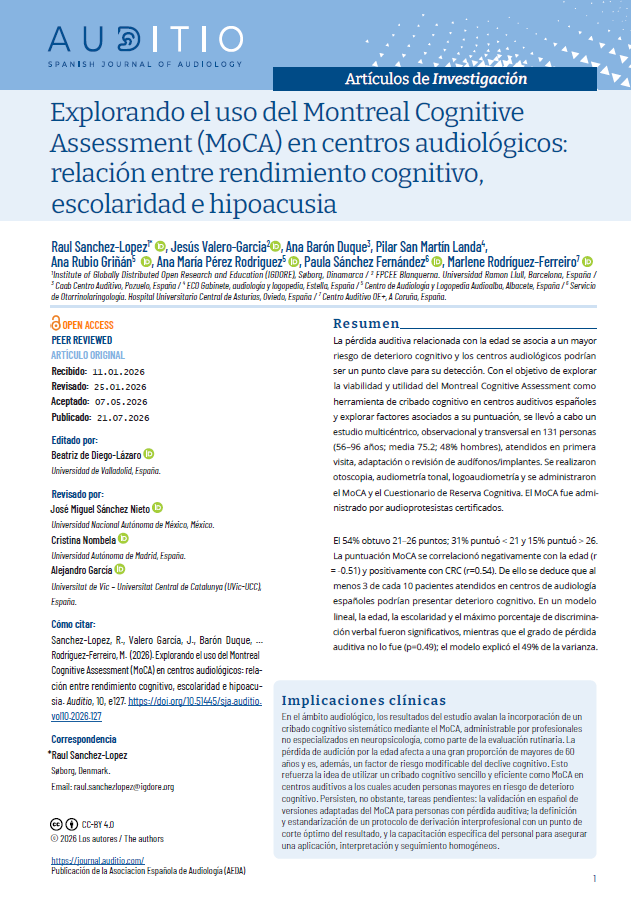
This multicenter, observational, and cross-sectional study evaluated the feasibility and utility of the Montreal Cognitive Assessment (MoCA, v8.1) as a cognitive screening tool in independent Spanish hearing centers. The sample included 131 people aged 56–96 years (mean 75.2; 48% men), in first visit, fitting, or review of hearing aids/implants. Audiological tests (otoscopy, pure-tone audiometry, speech audiometry) and Cognitive Reserve (CRC) were collected. The MoCA was administered by certified hearing aid specialists.
The MoCA scores were concentrated between 20–25, with 21 being the cutoff point used in several studies as indicative of cognitive impairment, and in others 26 is taken as the cutoff point for the absence of impairment. 31% of the people explored presented a score lower than 21, which highlights that 3 out of every 10 patients treated in Spanish audiology centers could present cognitive impairment. The analysis of variance showed that the most significant factors of the MoCA were age and schooling and the maximum verbal discrimination percentage, while the degree of hearing loss and the type of speech audiometry curve showed a significant effect. The MoCA correlated positively with the CRC (R=0.50); the results of participants with a level of schooling lower than secondary education obtained significantly lower scores.
As a whole, the data support making efforts to favor the systematic integration of cognitive screening in audiology centers and to study more deeply the association of maximum discrimination and cognitive impairment.
Downloads
Visibility and Altmetrics
Metrics
Global Statistics ℹ️
|
1322
Views
|
777
Downloads
|
|
2099
Total
|
|
References
American Speech-Language-Hearing Association. (1978). Guidelines for manual pure-tone threshold audiometry. Asha, 20, 297–301.
American Speech-Language-Hearing Association. (2024). The Value of Audiology: Hearing Loss and Cognitive Decline/Dementia. www.asha.org/siteassets/ebp/dov/value-of-audiology-hearing-loss-and-cognitive-decline-dementia.pdf
Belz, M. et al. (2025). Results from AD-HEARING (ADherence to and adjustment of HEARING aids in clinical routine care as preventive dementia strategy): a prospective 6-month follow-up study on cognition and psychological well-being. Frontiers in Psychiatry. Psychiatry, 16. https://doi.org/10.3389/fpsyt.2025.1494197
Bisogno, A., Scarpa, A., Girolamo, S., Luca, P., Cassandro, C., Viola, P., Ricciardiello, F., Greco, A., Vincentiis, M. D., Ralli, M., & Stadio, A. (2021). Hearing Loss and Cognitive Impairment: Epidemiology, Common Pathophysiological Findings, and Treatment Considerations. Life, 11(10), 1102. https://doi.org/10.3390/life11101102
Broome, E. E., Tannirandorn, P., Straus, J., Beale, P., Heffernan, E., Dening, T., & Henshaw, H. (2023). Patient perceptions of cognitive screening in adult audiology services: A qualitative exploration. Frontiers in Neurology, 14, 1143128. https://doi.org/10.3389/fneur.2023.1143128
Bucholc, M., Bauermeister, S., Kaur, D., McClean, P. L., & Todd, S. (2022). The impact of hearing impairment and hearing aid use on progression to mild cognitive impairment in cognitively healthy adults: An observational cohort study. Alzheimer’s & Dementia, 8(1), 12248. https://doi.org/10.1002/trc2.12248
Bureau International d’AudioPhonologie. (1997). Clasificación audiométrica de las deficiencias auditivas: Recomendación BIAP 02/1. https://www.biap.org/fr/recommandations/recomendaciones/ct-02-clasificacio-n-de-las-deficiencias-auditivas/112-rec-02-01-es-clasificacion-audiometrica-de-las-deficiencias-auditivas/file
Cantuaria, M. L., Pedersen, E. R., Waldorff, F. B., Wermuth, L., Pedersen, K. M., Poulsen, A. H., Raaschou-Nielsen, O., Sørensen, M., & Schmidt, J. H. (2024). Hearing Loss, Hearing Aid Use, and Risk of Dementia in Older Adults. JAMA Otolaryngology–Head & Neck Surgery, 150(2), 157. https://doi.org/10.1001/jamaoto.2023.3509
Cárdenas, M. R. de, & Marrero Aguiar, V. (1994). Cuaderno de logoaudiometría. Universidad Nacional de Educación a Distancia.
Castiglione, A., Casa, M., Gallo, S., Sorrentino, F., Dhima, S., Cilia, D., Lovo, E., Gambin, M., Previato, M., Colombo, S., Caserta, E., Gheller, F., Giacomelli, C., Montino, S., Limongi, F., Brotto, D., Gabelli, C., Trevisi, P., Bovo, R., & Martini, A. (2019). Correspondence Between Cognitive and Audiological Evaluations Among the Elderly: A Preliminary Report of an Audiological Screening Model of Subjects at Risk of Cognitive Decline With Slight to Moderate Hearing Loss. Frontiers in Neuroscience, 13, 1279. https://doi.org/10.3389/fnins.2019.01279
Dawes, P., Reeves, D., Yeung, W. K., Holland, F., Charalambous, A. P., Côté, M., David, R., Helmer, C., Laforce, R., Martins, R. N., Politis, A., Pye, A., Russell, G., Sheikh, S., Sirois, M., Sohrabi, H. R., Thodi, C., Gallant, K., Nasreddine, Z., & Leroi, I. (2023). Development and validation of the Montreal cognitive assessment for people with hearing impairment (MoCA-H). Journal of the American Geriatrics Society, 71(5), 1485-1494.
Delgado, C., Araneda, A., & Behrens, M. I. (2019). Validación del instrumento Montreal Cognitive Assessment en español en adultos mayores de 60 años. Neurología, 34(6), 376–385. https://doi.org/10.1016/j.nrl.2017.01.013
Dubno, J. R., Eckert, M. A., Lee, F.-S., Matthews, L. J., & Schmiedt, R. A. (2013). Classifying Human Audiometric Phenotypes of Age-Related Hearing Loss from Animal Models. Journal of the Association for Research in Otolaryngology, 14(5), 687–701. https://doi.org/10.1007/s10162-013-0396-x
Folstein, M. F., Folstein, S. E., & McHugh, P. R. (1975). "Mini-mental state". A practical method for grading the cognitive state of patients for the clinician. Journal of Psychiatric Research, 12(3), 189–198. https://doi.org/10.1016/0022-3956(75)90026-6
Francis, L., Seshadri, S., Dillard, L. K., Kujawa, S. G., Welling, D. B., Alcabes, R. L., & Beiser, A. S. (2025). Self-Reported Hearing Aid Use and Risk of Incident Dementia. JAMA Neurology, 82(11), 1195. https://doi.org/10.1001/jamaneurol.2025.2713
Füllgrabe, C. (2020). On the Possible Overestimation of Cognitive Decline: The Impact of Age-Related Hearing Loss on Cognitive-Test Performance. Frontiers in Neuroscience, 14, 454. https://doi.org/10.3389/fnins.2020.00454
Füllgrabe, C., Moore, B. C. J., & Stone, M. A. (2015). Age-group differences in speech identification despite matched audiometrically normal hearing: Contributions from auditory temporal processing and cognition. Frontiers in Aging Neuroscience, 6. https://doi.org/10.3389/fnagi.2014.00347
Gelfand, S. A., & Calandruccio, L. (Eds.). (2023). Essentials of Audiology (5.ª edición). Thieme Publishers. https://doi.org/10.1055/b000000430
Ismail, Y. A., Auf, H. A., Sadik, S. A., Ahmed, N. M., & Ali, Y. (2025). Sensitivity and specificity of the Montreal cognitive assessment using U.S. National alzheimer coordinating centre uniform data set: a retrospective analysis of 16,309 participants. BMC Neurology, 25(1), 381. https://doi.org/10.1186/s12883-025-04190-9
Lin, F. R., Metter, E. J., O’Brien, R. J., Resnick, S. M., Zonderman, A. B., & Ferrucci, L. (2011). Hearing loss and incident dementia. Archives of Neurology, 68(2), 214–220. https://doi.org/10.1001/archneurol.2010.362
Lin, F. R., Pike, J. R., Albert, M. S., Arnold, M., Burgard, S., Chisolm, T., Couper, D., Deal, J. A., Goman, A. M., Glynn, N. W., Gmelin, T., Gravens-Mueller, L., Hayden, K. M., Huang, A. R., Knopman, D., Mitchell, C. M., Mosley, T., Pankow, J. S., Reed, N. S., & Group, A. C. H. I. E. V. E. C. R. (2023). Hearing intervention versus health education control to reduce cognitive decline in older adults with hearing loss in the USA (ACHIEVE): A multicentre, randomised controlled trial. The Lancet, 402(10404), 786–797. https://doi.org/10.1016/S0140-6736(23)01406-X
Livingston, G., Huntley, J., K., L., Costafreda, G., Selbaek, G., & Allad, S. (2024). Dementia prevention, intervention, and care: 2024 report of the Lancet Commission. The Lancet, 404(10452), 572–628. https://doi.org/10.1016/S0140-6736(20)30367-6
Livingston, G., Huntley, J., Sommerlad, A., Ames, D., Ballard, C., Banerjee, S., Brayne, C., Burns, A., Cohen-Mansfield, J., Cooper, C., Costafreda, S. G., Dias, A., Fox, N., Gitlin, L. N., Howard, R., Kales, H. C., Kivimäki, M., Larson, E. B., Ogunniyi, A., & Mukadam, N. (2020). Dementia prevention, intervention, and care: 2020 report of the Lancet Commission. The Lancet, 396(10248), 413–446. https://doi.org/10.1016/S0140-6736(20)30367-6
Luis, C. A., Keegan, A. P., & Mullan, M. (2009). Cross validation of the Montreal Cognitive Assessment in community dwelling older adults residing in the Southeastern US. International Journal of Geriatric Psychiatry, 24(2), 197–201. https://doi.org/10.1002/gps.2101
Martino, P., Caycho-Rodríguez, T., Valencia, P. D., Politis, D., Gallegos, M., De Bortoli, M. A., & Cervigni, M. (2022). Cognitive Reserve Questionnaire: Psychometric analysis from the item response theory. Revista de Neurología, 75(7), 173–180. https://doi.org/10.33588/rn.7507.2022113
McClannahan, K. S., Mainardi, A., Luor, A., Chiu, Y.-F., Sommers, M. S., & Peelle, J. E. (2022). Spoken Word Recognition in Listeners with Mild Dementia Symptoms. Journal of Alzheimer’s Disease, 90(2), 749–759. https://doi.org/10.3233/JAD-215606
McDaid, D., Park, A.-L., & Chadha, S. (2021). Estimating the global costs of hearing loss. International Journal of Audiology, 60(3), 162–170. https://doi.org/10.1080/14992027.2021.1883197
Moore, B. C. J. (2003). Cochlear hearing loss (Repr). Whurr Publ.
Nasreddine, Z. S., Phillips, N. A., Bédirian, V., Charbonneau, S., Whitehead, V., Collin, I., Cummings, J. L., & Chertkow, H. (2005). The Montreal Cognitive Assessment, MoCA: a brief screening tool for mild cognitive impairment. Journal of the American Geriatrics Society, 53(4), 695–699. https://doi.org/10.1111/j.1532-5415.2005.53221.x
Naylor, G., Dillard, L. K., & Saunders, G. H. (2024). Hearing Aid Use and Risk of Dementia. JAMA Otolaryngology–Head & Neck Surgery, 150(7), 631–632. https://doi.org/10.1001/jamaoto.2024.0609
Nishiyama, T., Kimizuka, T., & Kataoka, C. (2025). Relationship between hearing thresholds and cognitive function in hearing aid non-users and long-term users post-midlife. Npj Aging, 11(14). https://doi.org/10.1038/s41514-025-00203-6
Organización Mundial de la Salud. (2021). Informe mundial sobre la audición. https://www.who.int/publications/i/item/world-report-on-hearing
Pinto, T. C. C., Machado, L., Bulgacov, T. M., Rodrigues-Júnior, A. L., Costa, M. L. G., Ximenes, R. C. C., & Sougey, E. B. (2019). Is the Montreal Cognitive Assessment (MoCA) screening superior to the Mini-Mental State Examination (MMSE) in the detection of mild cognitive impairment (MCI) and Alzheimer’s Disease (AD) in the elderly? International Psychogeriatrics, 31(4), 491–504. https://doi.org/10.1017/S1041610218001370
Połtyn-Zaradna, K., Pazdro-Zastawny, K., Szcześniak, D., Basiak-Rasała, A., Wołyniec, M., Zatońska, K., & Zatoński, T. (2025). Age-related hearing loss associated with cognitive impairment in the Polish cohort of the PURE study. Frontiers in Aging Neuroscience, 17, 1540803. https://doi.org/10.3389/fnagi.2025.1540803
Rami, L., Valls-Pedret, C., Bartrés-Faz, D., Caprile, C., Solé-Padullés, C., Castellví, M., Olives, J., Bosch, B., & Molinuevo, J. L. (2011). Cuestionario de reserva cognitiva. Valores obtenidos en población anciana sana y con enfermedad de Alzheimer. Revista de Neurología, 52, 195–201. https://doi.org/10.33588/rn.5204.2010478
Sánchez-Nieto, J. M., & Mendoza-Núñez, V. M. (2021). Prevalencia de probable deterioro cognitivo en adultos mayores de una población mexicana utilizando el MMSE y el MoCA. Gerokomos, 32(3), 168–171. https://doi.org/10.4321/S1134-928X2021000400007
Schafer, E. C., Miller, S., Lam, B. P. W., Lee, D., Lohrey, M., Eason, A., Nedrud, C., Cairo, K., Olvera, G., Klarmann, R., Brooks, B., Cumiskey, B., Kruse, C., Johnson, D., Laroi, A., & Musselman, M. (2025). Impact of Short-Term Hearing Aid Use on Cognitive Performance, Noise Acceptance, and Self-Perceived Benefit. American Journal of Audiology, 34(3), 707–721. https://doi.org/10.1044/2025_AJA-25-00039
Shen, J., Anderson, M. C., Arehart, K. H., & Souza, P. E. (2016). Using Cognitive Screening Tests in Audiology. American Journal of Audiology, 25(4), 319–331. https://doi.org/10.1044/2016_AJA-16-0032
Silverman, C. A., Silman, S., Emmer, M. B., Schoepflin, J. R., & Lutolf, J. J. (2006). Auditory Deprivation in Adults with Asymmetric, Sensorineural Hearing Impairment. Journal of the American Academy of Audiology, 17(10), 747–762. https://doi.org/10.3766/jaaa.17.10.6
Stern, Y. (2009). Cognitive reserve. Neuropsychologia, 47(10), 2015–2028. https://doi.org/10.1016/j.neuropsychologia.2009.03.004
Stern, Y. (2012). Cognitive reserve in ageing and Alzheimer’s disease. The Lancet Neurology, 11(11), 1006–1012. https://doi.org/10.1016/S1474-4422(12)70191-6
Uchida, Y., Sugiura, S., Nishita, Y., Saji, N., Sone, M., & Ueda, H. (2019). Age-related hearing loss and cognitive decline—The potential mechanisms linking the two. Auris, Nasus, Larynx, 46(1), 1–9. https://doi.org/10.1016/j.anl.2018.08.010
Valero-García, J., & Vila-Rovira, J. M. (2018). Estudio descriptivo de la prevalencia de la presbiacusia en una población del cinturón industrial de Barcelona. European Journal of Investigation in Health, Psychology and Education, 8(2), 79. https://doi.org/10.30552/ejihpe.v8i2.246
Wasano, K., Nakagawa, T., Kaga, K., & Ogawa, K. (2024). The effect of aging and asymmetrical hearing on speech discrimination. Communications Medicine, 4(1), 166. https://doi.org/10.1038/s43856-024-00587-8
Yeung, P., Wong, L., Chan, C., Leung, J. L., & Yung, C. (2014). A validation study of the Hong Kong version of Montreal Cognitive Assessment (HK-MoCA) in Chinese older adults in Hong Kong. Hong Kong Medical Journal. https://doi.org/10.12809/hkmj144219
Downloads
Published
How to Cite
License
Copyright (c) 2026 Raul Sanchez-Lopez, Jesus Valero-García, Ana Barón Duque, Pilar San Martín Landa, Ana Rubio Griñán, Ana María Pérez Rodríguez, Paula Sánchez Fernández, Marlene Rodríguez-Ferreiro

This work is licensed under a Creative Commons Attribution 4.0 International License.
All articles will be published under the open Creative Commons Attribution (CC-BY) license. This license allows others to share and adapt the content, even for commercial purposes, as long as appropriate credit is given to the authors and the journal. By submitting their manuscript, authors retain copyright but grant the journal the right to make the first publication under this license.
More information about this license is available at: https://creativecommons.org/licenses/by/4.0/
Articles published between 2001 and 2020
The texts published in this journal in the section "AUDITIO 2001-2020" are subject - unless otherwise indicated - to a Creative Commons Attribution 3.0 Spain license. You can copy, distribute, communicate them publicly, make derivative works and commercial uses provided that you acknowledge the credits of the works (authorship, name of the journal, publishing institution) in the manner specified by the authors or by the journal. The full license can be consulted at http://creativecommons.org/licenses/by/3.0/es/deed.es.