Una implementación en línea del Método ECAP Panorámico para estimar patrones de dispersión de corriente y respuesta neural en usuarios de implante coclear
DOI:
https://doi.org/10.51445/sja.auditio.vol10.2026.128Palabras clave:
Implante coclear, ECAP, salud neural, dispersión de corriente, medidas objetivas, implementación en líneaResumen
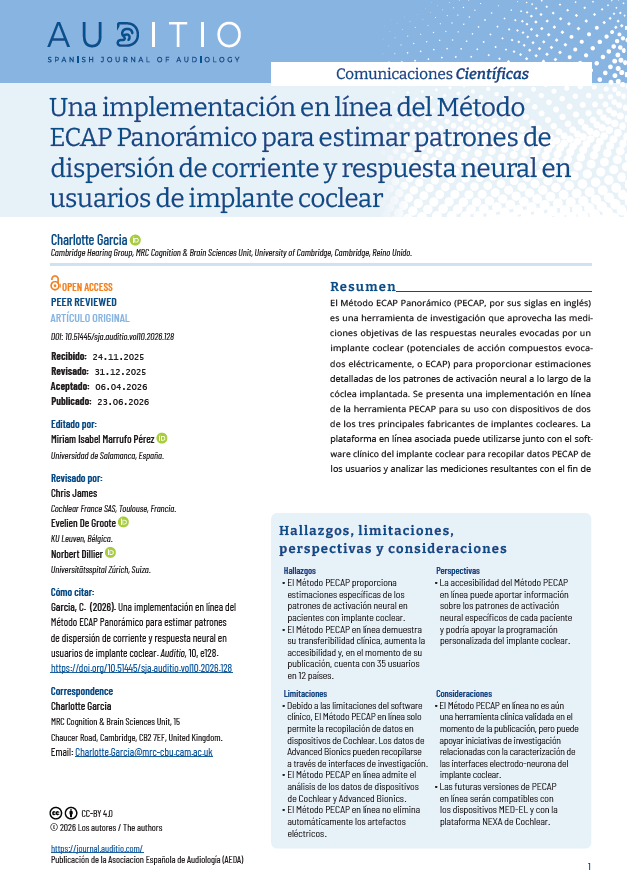
El Método ECAP Panorámico (PECAP, por sus siglas en inglés) es una herramienta de investigación que aprovecha las mediciones objetivas de las respuestas neurales evocadas por un implante coclear (potenciales de acción compuestos evocados eléctricamente, o ECAP) para proporcionar estimaciones detalladas de los patrones de activación neural a lo largo de la cóclea implantada. Se presenta una implementación en línea de la herramienta PECAP para su uso con dispositivos de dos de los tres principales fabricantes de implantes cocleares. La plataforma en línea asociada puede utilizarse junto con el software clínico del implante coclear para recopilar datos PECAP de los usuarios y analizar las mediciones resultantes con el fin de predecir estimaciones personalizadas de dispersión de corriente y respuesta neural para cada electrodo activo en el software clínico del paciente.
Descargas
Visibility and Altmetrics
Métricas
Estadísticas globales ℹ️
|
1777
Visualizaciones
|
1765
Descargas
|
|
3542
Total
|
|
Citas
Abbas, P. J., Brown, C. J., Shallop, J. K., Firszt, J. B., Hughes, M. L., Hong, S. H., & Staller, S. J. (1999). Summary of results using the nucleus CI24M implant to record the electrically evoked compound action potential. Ear and Hearing, 20(1), 45–59. https://doi.org/10.1097/00003446-199902000-00005 DOI: https://doi.org/10.1097/00003446-199902000-00005
Bierer, J. A. (2010). Probing the Electrode–Neuron Interface With Focused Cochlear Implant Stimulation. Trends in Amplification, 14(2), 84–95. https://doi.org/10.1177/1084713810375249 DOI: https://doi.org/10.1177/1084713810375249
Biesheuvel, J. D., Briaire, J. J., & Frijns, J. H. M. (2016). A Novel Algorithm to Derive Spread of Excitation Based on Deconvolution. Ear and Hearing, 37(5), 572. https://doi.org/10.1097/AUD.0000000000000296 DOI: https://doi.org/10.1097/AUD.0000000000000296
Blamey, P., Artieres, F., Başkent, D., Bergeron, F., Beynon, A., Burke, E., Dillier, N., Dowell, R., Fraysse, B., Gallégo, S., Govaerts, P. J., Green, K., Huber, A. M., Kleine-Punte, A., Maat, B., Marx, M., Mawman, D., Mosnier, I., O’Connor, A. F., … Lazard, D. S. (2013). Factors affecting auditory performance of postlinguistically deaf adults using cochlear implants: An update with 2251 patients. Audiology & Neuro-Otology, 18(1), 36–47. https://doi.org/10.1159/000343189 DOI: https://doi.org/10.1159/000343189
Brochier, T., Guérit, F., Deeks, J. M., Garcia, C., Bance, M., & Carlyon, R. P. (2021). Evaluating and Comparing Behavioural and Electrophysiological Estimates of Neural Health in Cochlear Implant Users. JARO: Journal of the Association for Research in Otolaryngology, 22(1), 67–80. https://doi.org/10.1007/s10162-020-00773-0 DOI: https://doi.org/10.31234/osf.io/2kp7x
Brown, C. J., Abbas, P. J., & Gantz, B. (1990). Electrically evoked whole-nerve action potentials: Data from human cochlear implant users. The Journal of the Acoustical Society of America, 88(3), 1385–1391. https://doi.org/10.1121/1.399716 DOI: https://doi.org/10.1121/1.399716
Carlyon, R. P., Cosentino, S., Deeks, J. M., Parkinson, W., & Arenberg, J. A. (2018). Effect of Stimulus Polarity on Detection Thresholds in Cochlear Implant Users: Relationships with Average Threshold, Gap Detection, and Rate Discrimination. JARO: Journal of the Association for Research in Otolaryngology, 19(5), 559–567. https://doi.org/10.1007/s10162-018-0677-5 DOI: https://doi.org/10.1007/s10162-018-0677-5
Charlet de Sauvage, R., Cazals, Y., Erre, J. P., & Aran, J. M. (1983). Acoustically derived auditory nerve action potential evoked by electrical stimulation: An estimation of the waveform of single unit contribution. The Journal of the Acoustical Society of America, 73(2), 616–627. https://doi.org/10.1121/1.388872 DOI: https://doi.org/10.1121/1.388872
Cohen, L. T., Richardson, L. M., Saunders, E., & Cowan, R. S. C. (2003). Spatial spread of neural excitation in cochlear implant recipients: Comparison of improved ECAP method and psychophysical forward masking. Hearing Research, 179(1), 72–87. https://doi.org/10.1016/S0378-5955(03)00096-0 DOI: https://doi.org/10.1016/S0378-5955(03)00096-0
Cosentino, S., Gaudrain, E., Deeks, J. M., & Carlyon, R. P. (2015). Multistage Nonlinear Optimization to Recover Neural Activation Patterns From Evoked Compound Action Potentials of Cochlear Implant Users. IEEE Transactions on Biomedical Engineering, 63(4), 833–840. https://doi.org/10.1109/TBME.2015.2476373 DOI: https://doi.org/10.1109/TBME.2015.2476373
Davis, T. J., Zhang, D., Gifford, R. H., Dawant, B. M., Labadie, R. F., & Noble, J. H. (2016). Relationship Between Electrode-to-Modiolus Distance and Current Levels for Adults with Cochlear Implants. Otology & Neurotology: Official Publication of the American Otological Society, American Neurotology Society [and] European Academy of Otology and Neurotology, 37(1), 31–37. https://doi.org/10.1097/MAO.0000000000000896 DOI: https://doi.org/10.1097/MAO.0000000000000896
Dawson, P., Fullerton, A., Krishnamoorthi, H., Plant, K., Cowan, R., Buczak, N., Long, C. J., James, C. J., Sismono, F., & Büchner, A. (2025a, July). A prospective, multi-centre case-control trial examining factors that predict variable clinical performance in postlingual adult CI recipients (PREVA) [Poster]. Conference on Implantable Auditory Prostheses (CIAP).
Dawson, P., Fullerton, A., Krishnamoorthi, H., Plant, K., Cowan, R., Buczak, N., Long, C., James, C. J., Sismono, F., & Büchner, A. (2025b). A Prospective, Multicentre Case-Control Trial Examining Factors That Explain Variable Clinical Performance in Post Lingual Adult CI Recipients. Trends in Hearing, 29, 23312165251347138. https://doi.org/10.1177/23312165251347138 DOI: https://doi.org/10.1177/23312165251347138
de Vos, J. J., Biesheuvel, J. D., Briaire, J. J., Boot, P. S., van Gendt, M. J., Dekkers, O. M., Fiocco, M., & Frijns, J. H. M. (2018). Use of Electrically Evoked Compound Action Potentials for Cochlear Implant Fitting: A Systematic Review. Ear and Hearing, 39(3), 401–411. https://doi.org/10.1097/AUD.0000000000000495 DOI: https://doi.org/10.1097/AUD.0000000000000495
DeVries, L., Scheperle, R., & Bierer, J. A. (2016). Assessing the Electrode-Neuron Interface with the Electrically Evoked Compound Action Potential, Electrode Position, and Behavioral Thresholds. JARO: Journal of the Association for Research in Otolaryngology, 17(3), 237–252. https://doi.org/10.1007/s10162-016-0557-9 DOI: https://doi.org/10.1007/s10162-016-0557-9
Firszt, J. B., Holden, L. K., Skinner, M. W., Tobey, E. A., Peterson, A., Gaggl, W., Runge-Samuelson, C. L., & Wackym, P. A. (2004). Recognition of speech presented at soft to loud levels by adult cochlear implant recipients of three cochlear implant systems. Ear and Hearing, 25(4), 375–387. https://doi.org/10.1097/01.aud.0000134552.22205.ee DOI: https://doi.org/10.1097/01.AUD.0000134552.22205.EE
Friesen, L. M., Shannon, R. V., Baskent, D., & Wang, X. (2001). Speech recognition in noise as a function of the number of spectral channels: Comparison of acoustic hearing and cochlear implants. The Journal of the Acoustical Society of America, 110(2), 1150–1163. https://doi.org/10.1121/1.1381538 DOI: https://doi.org/10.1121/1.1381538
Garcia, C. (2022). The Panoramic ECAP Method: Estimating patient-specific patterns of current spread and neural health in cochlear-implant users. https://www.repository.cam.ac.uk/handle/1810/341691
Garcia, C., & Carlyon, R. P. (2025). Assessing Array-Type Differences in Cochlear Implant Users Using the Panoramic ECAP Method. Ear and Hearing, 46(5), 1355. https://doi.org/10.1097/AUD.0000000000001673 DOI: https://doi.org/10.1097/AUD.0000000000001673
Garcia, C., Deeks, J. M., Goehring, T., Borsetto, D., Bance, M., & Carlyon, R. P. (2023). SpeedCAP: An Efficient Method for Estimating Neural Activation Patterns Using Electrically Evoked Compound Action-Potentials in Cochlear Implant Users. Ear and Hearing, 44(3), 627. https://doi.org/10.1097/AUD.0000000000001305 DOI: https://doi.org/10.1097/AUD.0000000000001305
Garcia, C., Goehring, T., Cosentino, S., Turner, R. E., Deeks, J. M., Brochier, T., Rughooputh, T., Bance, M., & Carlyon, R. P. (2021). The Panoramic ECAP Method: Estimating Patient-Specific Patterns of Current Spread and Neural Health in Cochlear Implant Users. Journal of the Association for Research in Otolaryngology: JARO, 22(5), 567–589. https://doi.org/10.1007/s10162-021-00795-2 DOI: https://doi.org/10.1007/s10162-021-00795-2
Garcia, C., Morse-Fortier, C., Guérit, F., Hislop, S., Goehring, T., Carlyon, R. P., & Arenberg, J. G. (2024). Investigating the Effect of Blurring and Focusing Current in Cochlear Implant Users with the Panoramic ECAP Method. Journal of the Association for Research in Otolaryngology, 25(6), 591–609. https://doi.org/10.1007/s10162-024-00966-x DOI: https://doi.org/10.1007/s10162-024-00966-x
Garcia, C., Sismono, F., Goehring, T., Guérit, F., Arzounian, D., & Carlyon, R. P. (2025). A comparison of electrophysiological measures for characterizing the cochlear-implant electrode-neuron interface. JASA Express Letters, 5(8), 082001. https://doi.org/10.1121/10.0038746 DOI: https://doi.org/10.1121/10.0038746
Goehring, T., Archer-Boyd, A. W., Arenberg, J. G., & Carlyon, R. P. (2021). The effect of increased channel interaction on speech perception with cochlear implants. Scientific Reports, 11(1), Article 1. https://doi.org/10.1038/s41598-021-89932-8 DOI: https://doi.org/10.1038/s41598-021-89932-8
Goehring, T., Arenberg, J. G., & Carlyon, R. P. (2020). Using Spectral Blurring to Assess Effects of Channel Interaction on Speech-in-Noise Perception with Cochlear Implants. JARO: Journal of the Association for Research in Otolaryngology, 21(4), 353–371. https://doi.org/10.1007/s10162-020-00758-z DOI: https://doi.org/10.1007/s10162-020-00758-z
Goldwyn, J. H., Bierer, S. M., & Bierer, J. A. (2010). Modeling the electrode-neuron interface of cochlear implants: Effects of neural survival, electrode placement, and the partial tripolar configuration. Hearing Research, 268(1–2), 93–104. https://doi.org/10.1016/j.heares.2010.05.005 DOI: https://doi.org/10.1016/j.heares.2010.05.005
He, S., Shahsavarani, B. S., McFayden, T. C., Wang, H., Gill, K. E., Xu, L., Chao, X., Luo, J., Wang, R., & He, N. (2018). Responsiveness of the Electrically Stimulated Cochlear Nerve in Children with Cochlear Nerve Deficiency. Ear and Hearing, 39(2), 238–250. https://doi.org/10.1097/AUD.0000000000000467 DOI: https://doi.org/10.1097/AUD.0000000000000467
Holden, L. K., Finley, C. C., Firszt, J. B., Holden, T. A., Brenner, C., Potts, L. G., Gotter, B. D., Vanderhoof, S. S., Mispagel, K., Heydebrand, G., & Skinner, M. W. (2013). Factors Affecting Open-Set Word Recognition in Adults With Cochlear Implants. Ear & Hearing, 34(3), 342–360. https://doi.org/10.1097/AUD.0b013e3182741aa7 DOI: https://doi.org/10.1097/AUD.0b013e3182741aa7
Hrncirik, F., Roberts, I. V., Swords, C., Christopher, P. J., Chhabu, A., Gee, A. H., & Bance, M. L. (2022). Impact of Scala Tympani Geometry on Insertion Forces during Implantation. Biosensors, 12(11), 999. https://doi.org/10.3390/bios12110999 DOI: https://doi.org/10.3390/bios12110999
Hughes, M. L., & Stille, L. J. (2010). Effect of stimulus and recording parameters on spatial spread of excitation and masking patterns obtained with the electrically evoked compound action potential in cochlear implants. Ear and Hearing, 31(5), 679–692. https://doi.org/10.1097/AUD.0b013e3181e1d19e DOI: https://doi.org/10.1097/AUD.0b013e3181e1d19e
Jwair, S., Prins, A., Wegner, I., Stokroos, R. J., Versnel, H., & Thomeer, H. G. X. M. (2021). Scalar Translocation Comparison Between Lateral Wall and Perimodiolar Cochlear Implant Arrays—A Meta-Analysis. The Laryngoscope, 131(6), 1358–1368. https://doi.org/10.1002/lary.29224 DOI: https://doi.org/10.1002/lary.29224
Jwair, S., Versnel, H., Stokroos, R. J., & Thomeer, H. G. X. M. (2022). The effect of the surgical approach and cochlear implant electrode on the structural integrity of the cochlea in human temporal bones. Scientific Reports, 12(1), 17068. https://doi.org/10.1038/s41598-022-21399-7 DOI: https://doi.org/10.1038/s41598-022-21399-7
Kalkman, R. K., Briaire, J. J., Dekker, D. M. T., & Frijns, J. H. M. (2022). The relation between polarity sensitivity and neural degeneration in a computational model of cochlear implant stimulation. Hearing Research, 415, 108413. https://doi.org/10.1016/j.heares.2021.108413 DOI: https://doi.org/10.1016/j.heares.2021.108413
Kim, J.-R., Tejani, V. D., Abbas, P. J., & Brown, C. J. (2017). Intracochlear Recordings of Acoustically and Electrically Evoked Potentials in Nucleus Hybrid L24 Cochlear Implant Users and Their Relationship to Speech Perception. Frontiers in Neuroscience, 11. https://doi.org/10.3389/fnins.2017.00216 DOI: https://doi.org/10.3389/fnins.2017.00216
Konerding, W., Arenberg, J., Sznabel, D., Kral, A., & Baumhoff, P. (2025). An Electrically Evoked Compound Action Potential Marker for Local Spiral Ganglion Neuron Degeneration: The Failure Index. Journal of Neuroscience, 45(7). https://doi.org/10.1523/JNEUROSCI.0954-24.2024 DOI: https://doi.org/10.1523/JNEUROSCI.0954-24.2024
Lazard, D. S., Vincent, C., Venail, F., Van de Heyning, P., Truy, E., Sterkers, O., Skarzynski, P. H., Skarzynski, H., Schauwers, K., O’Leary, S., Mawman, D., Maat, B., Kleine-Punte, A., Huber, A. M., Green, K., Govaerts, P. J., Fraysse, B., Dowell, R., Dillier, N., … Blamey, P. J. (2012). Pre-, per- and postoperative factors affecting performance of postlinguistically deaf adults using cochlear implants: A new conceptual model over time. PloS One, 7(11), e48739. https://doi.org/10.1371/journal.pone.0048739 DOI: https://doi.org/10.1371/journal.pone.0048739
McKay, C. M., Chandan, K., Akhoun, I., Siciliano, C., & Kluk, K. (2013). Can ECAP Measures Be Used for Totally Objective Programming of Cochlear Implants? JARO: Journal of the Association for Research in Otolaryngology, 14(6), 879–890. https://doi.org/10.1007/s10162-013-0417-9 DOI: https://doi.org/10.1007/s10162-013-0417-9
Mewes, A., Bennett, C., Dambon, J., Brademann, G., & Hey, M. (2023). Evaluation of CI electrode position from imaging: Comparison of an automated technique with the established manual method. BMC Medical Imaging, 23(1), 143. https://doi.org/10.1186/s12880-023-01102-6 DOI: https://doi.org/10.1186/s12880-023-01102-6
Moyaert, J., Gilles, A., Ramekers, D., Mertens, G., Fransen, E., Cardon, E., Biot, L., Verhelst, E., Van Rompaey, V., & Lammers, M. J. (2025). Cochlear health in a cohort of cochlear implant users carrying the p.Pro51Ser variant in the COCH gene (DFNA9): A cross-sectional study evaluating the changes in the electrically evoked compound action potential (eCAP). Hearing Research, 460, 109240. https://doi.org/10.1016/j.heares.2025.109240 DOI: https://doi.org/10.1016/j.heares.2025.109240
Mudry, A., & Mills, M. (2013). The Early History of the Cochlear Implant: A Retrospective. JAMA Otolaryngology–Head & Neck Surgery, 139(5), 446–453. https://doi.org/10.1001/jamaoto.2013.293 DOI: https://doi.org/10.1001/jamaoto.2013.293
Peng, T., Garcia, C., Haneman, M., Shader, M. J., Carlyon, R. P., & McKay, C. M. (2025). Comparing Patient-Specific Variations in Intra-Cochlear Neural Health Estimated Using Psychophysical Thresholds and Panoramic Electrically Evoked Compound Action Potentials (PECAPs). Journal of the Association for Research in Otolaryngology: JARO, 26(1), 77–91. https://doi.org/10.1007/s10162-024-00972-z DOI: https://doi.org/10.1007/s10162-024-00972-z
Pfingst, B. E., Zhou, N., Colesa, D. J., Watts, M. M., Strahl, S. B., Garadat, S. N., Schvartz-Leyzac, K. C., Budenz, C. L., Raphael, Y., & Zwolan, T. A. (2015). Importance of cochlear health for implant function. Hearing Research, 322, 77–88. https://doi.org/10.1016/j.heares.2014.09.009 DOI: https://doi.org/10.1016/j.heares.2014.09.009
Prado-Guitierrez, P., Fewster, L. M., Heasman, J. M., McKay, C. M., & Shepherd, R. K. (2006). Effect of interphase gap and pulse duration on electrically evoked potentials is correlated with auditory nerve survival. Hearing Research, 215(1–2), 47–55. https://doi.org/10.1016/j.heares.2006.03.006 DOI: https://doi.org/10.1016/j.heares.2006.03.006
Ramekers, D., Benav, H., Klis, S. F. L., & Versnel, H. (2022). Changes in the Electrically Evoked Compound Action Potential over time After Implantation and Subsequent Deafening in Guinea Pigs. Journal of the Association for Research in Otolaryngology, 23(6), 721–738. https://doi.org/10.1007/s10162-022-00864-0 DOI: https://doi.org/10.1007/s10162-022-00864-0
Ramekers, D., Versnel, H., Strahl, S. B., Smeets, E. M., Klis, S. F. L., & Grolman, W. (2014). Auditory-nerve responses to varied inter-phase gap and phase duration of the electric pulse stimulus as predictors for neuronal degeneration. Journal of the Association for Research in Otolaryngology: JARO, 15(2), 187–202. https://doi.org/10.1007/s10162-013-0440-x DOI: https://doi.org/10.1007/s10162-013-0440-x
Sismono, F., Leblans, M., Mancini, L., Veneziano, A., Zanini, F., Dirckx, J., Bernaerts, A., de Foer, B., Offeciers, E., & Zarowski, A. (2022). 3D-localisation of cochlear implant electrode contacts in relation to anatomical structures from in vivo cone-beam computed tomography. Hearing Research, 426, 108537. https://doi.org/10.1016/j.heares.2022.108537 DOI: https://doi.org/10.1016/j.heares.2022.108537
Skidmore, J., Xu, L., Chao, X., Riggs, W. J., Pellittieri, A., Vaughan, C., Ning, X., Wang, R., Luo, J., & He, S. (2021). Prediction of the Functional Status of the Cochlear Nerve in Individual Cochlear Implant Users Using Machine Learning and Electrophysiological Measures. Ear and Hearing, 42(1), 180. https://doi.org/10.1097/AUD.0000000000000916 DOI: https://doi.org/10.1097/AUD.0000000000000916
Swords, C. (2024). Anatomical and Electrical Characterisation of The Human Cochlea Towards the Improvement of Cochlear Implant Performance. https://doi.org/10.17863/CAM.112673
Wanna, G. B., Noble, J. H., Carlson, M. L., Gifford, R. H., Dietrich, M. S., Haynes, D. S., Dawant, B. M., & Labadie, R. F. (2014). Impact of electrode design and surgical approach on scalar location and cochlear implant outcomes. The Laryngoscope, 124 Suppl 6(0 6), S1-7. https://doi.org/10.1002/lary.24728 DOI: https://doi.org/10.1002/lary.24728
Wu, P. Z., Liberman, L. D., Bennett, K., de Gruttola, V., O’Malley, J. T., & Liberman, M. C. (2019). Primary Neural Degeneration in the Human Cochlea: Evidence for Hidden Hearing Loss in the Aging Ear. Neuroscience, Hearing Loss, Tinnitus, Hyperacusis, Central Gain, 407, 8–20. https://doi.org/10.1016/j.neuroscience.2018.07.053 DOI: https://doi.org/10.1016/j.neuroscience.2018.07.053
Zeng, F.-G. (2022). Celebrating the one millionth cochlear implant. JASA Express Letters, 2(7), 077201. https://doi.org/10.1121/10.0012825 DOI: https://doi.org/10.1121/10.0012825
Zhou, N., & Pfingst, B. E. (2014). Relationship between multipulse integration and speech recognition with cochlear implants. The Journal of the Acoustical Society of America, 136(3), 1257–1268. https://doi.org/10.1121/1.4890640 DOI: https://doi.org/10.1121/1.4890640
Publicado
Cómo citar
Licencia
Derechos de autor 2026 Charlotte Garcia

Esta obra está bajo una licencia internacional Creative Commons Atribución 4.0.
Todos los artículos serán publicados bajo la licencia abierta Creative Commons Attribution (CC-BY). Esta licencia permite a otros compartir y adaptar el contenido, incluso con fines comerciales, siempre que se dé el reconocimiento adecuado a los autores y a la revista. Al enviar su manuscrito, los autores retienen los derechos de autor pero otorgan a la revista el derecho a realizar la primera publicación bajo esta licencia.
Más información sobre esta licencia disponible en: https://creativecommons.org/licenses/by/4.0/
Publicaciones 2001-2020
Los textos publicados en esta revista en la seccion de "AUDITIO 2001-2020 están sujetos –si no se indica lo contrario– a una licencia de Reconocimiento 3.0 España de Creative Commons. Puede copiarlos, distribuirlos, comunicarlos públicamente, hacer obras derivadas y usos comerciales siempre que reconozca los créditos de las obras (autoría, nombre de la revista, institución editora) de la manera especificada por los autores o por la revista. La licencia completa se puede consultar en http://creativecommons.org/licenses/by/3.0/es/deed.es.






 AUDITIO | Spanish Journal of Audiology