
Assessment Tools and Practice Patterns in Adult Cochlear Implant Candidacy
Insights from Spanish-Speaking Countries
DOI:
https://doi.org/10.51445/sja.auditio.vol9.2025.124Keywords:
Cochlear implants, Hispanics, Spanish speakers, cochlear implant service deliveryAbstract
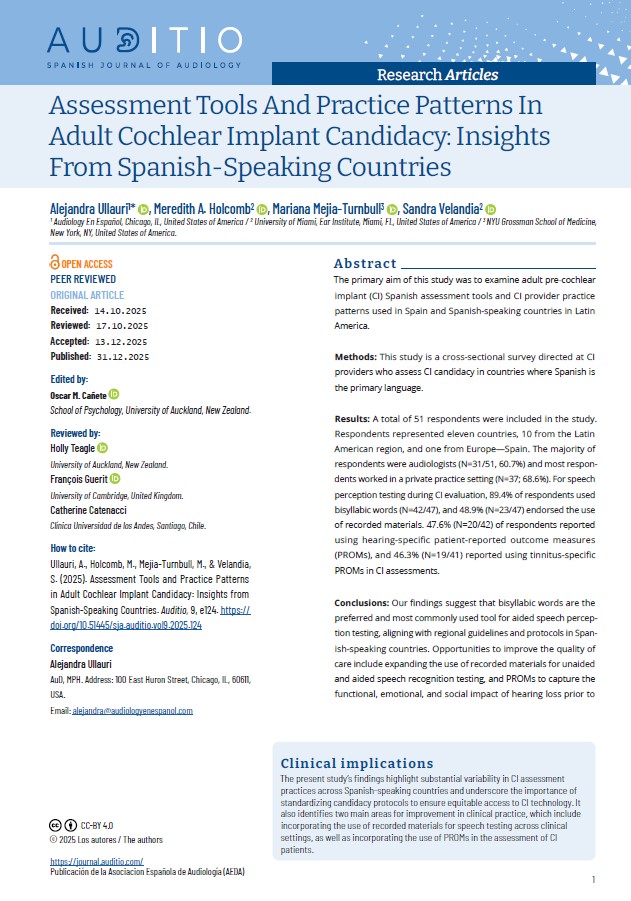
The primary aim of this study was to examine adult pre-cochlear implant (CI) Spanish assessment tools and CI provider practice patterns used in Spain and Spanish-speaking countries in Latin America.
Methods: This study is a cross-sectional survey directed to CI providers who assess CI candidacy in countries where Spanish is the primary language.
Results: A total of 51 respondents were included in the study. Respondents represented eleven countries, 10 from the Latin American region, and one from Europe—Spain. The majority of respondents were audiologists (N=31/51, 60.7%) and most respondents worked in a private practice setting (N=37; 68.6%). For speech perception testing during CI evaluation, the majority of respondents use bisyllabic words (N=42/47; 89.4%) and nearly half (N=23/47; 48.9%) endorsed use of recorded materials. Fewer than half of respondents reported using hearing-specific (N=20/42; 47.6%) or tinnitus-specific (N=19/41; 46.3%) patient-reported-outcome- measures (PROMs) in CI assessments.
Conclusions: Our findings suggest that bisyllabic words are the preferred and most commonly used tool for aided speech perception testing, aligning with regional guidelines and protocols in Spanish-speaking countries. Opportunities to improve quality of care include expanding the use of recorded materials for unaided and aided speech recognition testing and PROMs to capture the functional, emotional and social impact of hearing loss prior and after cochlear implantation. Additionally, the development of standardized guidelines and protocols that can be disseminated broadly would help ensure consistent assessment practices and improve care for Spanish-speaking patients worldwide.
Downloads
Visibility and Altmetrics
Metrics
Global Statistics ℹ️
|
2167
Views
|
942
Downloads
|
|
3109
Total
|
|
References
Abdala, C., Baron de Otero, C., Bevilacqua, M.C., Brik, G., Furmanski, H., Flores, L., Garrido, M., Mansilla, T., Orta, J., Pallares, N., & Sandford, D. (2003). Protocolo Latinoamericano de Implante Coclear – Cochlear Corporation. [Unpublished Manuscript]
Advanced Bionics (2025). Advanced Bionics Corporation Global Offices. https://www.advancedbionics.com/us/en/home/contact-us/f/ab-global-offices
Advanced Bionics (2025). Global Distributors. https://www.advancedbionics.com/us/en/home/contact-us/f/global-distributors
AEDA (2021). Consensus on audiological assessments (II): Speech Audiometry. Auditio, 1(3), 34–36. https://doi.org/10.51445/sja.auditio.vol1.2002.0015 (Original work published October 1, 2002) DOI: https://doi.org/10.51445/sja.auditio.vol1.2002.0015
American Speech Language Hearing Association (2024). Understanding Language Access Requirements for Audiologists and SLPs. https://www.asha.org/news/2024/understanding-language-access-requirements-for-audiologists-and-slps/
Benítez-Barrera, C. R., Skorupa, M., Hornsby, B. W. Y., Bolt, D. M., & de Diego-Lázaro, B. (2025). Psychometric validation of the Spanish-versions of the Vanderbilt fatigue scales for adults. International journal of audiology, 1–6. Advance online publication. https://doi.org/10.1080/14992027.2025.2502453 DOI: https://doi.org/10.1080/14992027.2025.2502453
Calvino, M., Gavilán, J., Sánchez-Cuadrado, I., Pérez-Mora, R. M., Muñoz, E., Díez-Sebastián, J., & Lassaletta, L. (2016). Using the HISQUI29 to assess the sound quality levels of Spanish adults with unilateral cochlear implants and no contralateral hearing. Eur Arch Otorhinolaryngol, 273(9), 2343–2353. https://doi.org/10.1007/s00405-015-3789-0 DOI: https://doi.org/10.1007/s00405-015-3789-0
Calvino, M., Sánchez-Cuadrado, I., Gavilán, J., & Lassaletta, L. (2023). Long-Term Non-Users of Transcutaneous Auditory Implants: Thirty Years of Experience at a Single Institution. International journal of environmental research and public health, 20(13), 6201. https://doi.org/10.3390/ijerph20136201 DOI: https://doi.org/10.3390/ijerph20136201
Cañete, O. M., Marfull, D., Torrente, M. C., & Purdy, S. C. (2022). The Spanish 12-item version of the Speech, Spatial and Qualities of Hearing scale (Sp-SSQ12): adaptation, reliability, and discriminant validity for people with and without hearing loss. Disability and rehabilitation, 44(8), 1419–1426. https://doi.org/10.1080/09638288.2020.1795279 DOI: https://doi.org/10.1080/09638288.2020.1795279
Carrillo, A., Medina, M. D. M., Polo, R., Alonso, D., Vaca, M., Muriel, A., Fernandez, B., Rivera, T., & Cobeta, I. (2019). Validation of the Hearing Handicap Inventory for Adults Scale for Spanish-Speaking Patients. Otology & neurotology: official publication of the American Otological Society, American Neurotology Society [and] European Academy of Otology and Neurotology, 40(10), e947–e954. https://doi.org/10.1097/MAO.0000000000002419 DOI: https://doi.org/10.1097/MAO.0000000000002419
CI Task Force (2023). Improving the standard of care for adults with hearing loss and the role of cochlear implantation: Living Guidelines. https://adulthearing.com/wp-content/uploads/2023/07/Living-Guidelines-for-Adult-Cochlear-Implantation-V1-2023_July20.pdf
Cochlear Ltd (2023). Representantes regionales de America Latina. https://www.cochlear.com/la/es/connect/contact-us
Cochlear Ltd (2025). Contáctenos. Oficina de España. https://www.cochlear.com/es/es/connect/contact-us
Corredor-Rojas, G. F., Ordoñez-Ordoñez, L. E., Franco-Aristizábal, C. F., & Macías-Tolosa, C. (2024). Hipoacusia neurosensorial: Diagnóstico y rehabilitación en adultos y niños. Acta Otorrinolaringológica & Cirugía de Cabeza y Cuello, 52(3), 266–282. https://doi.org/10.37076/acorl.v52i3.817 DOI: https://doi.org/10.37076/acorl.v52i3.817
Custodio, N., Duque, L., Montesinos, R., Alva-Diaz, C., Mellado, M., & Slachevsky, A. (2020). Systematic Review of the Diagnostic Validity of Brief Cognitive Screenings for Early Dementia Detection in Spanish-Speaking Adults in Latin America. Frontiers in aging neuroscience, 12, 270. https://doi.org/10.3389/fnagi.2020.00270 DOI: https://doi.org/10.3389/fnagi.2020.00270
Der, C., Alzérreca, E., San Martín, J. T., Román, L., Zamorano, I., Malhue, J., Aliaga, P., Coronelli, L., & Sarda, S. (2012). National linguistic validation of the Tinnitus Handicap Inventory (THI). Assessment of disability caused by tinnitus in Chilean Spanish-speaking population. The International Tinnitus Journal, 17(2), 146–151. https://doi.org/10.5935/0946-5448.20120026 DOI: https://doi.org/10.5935/0946-5448.20120026
Dunn, C. C., Zwolan, T. A., Balkany, T. J., Strader, H. L., Biever, A., Gifford, R. H., Hall, M. W., Holcomb, M. A., Hill, H., King, E. R., Larky, J., Presley, R., Reed, M., Shapiro, W. H., Sydlowski, S. A., & Wolfe, J. (2024). A Consensus to Revise the Minimum Speech Test Battery-Version 3. American journal of audiology, 33(3), 624–647. https://doi.org/10.1044/2024_AJA-24-00008 DOI: https://doi.org/10.1044/2024_AJA-24-00008
Giraudo, E., Chalabe, M., & Maritano, L. (2019). Protocolo de Evaluación de Resultados con Equipamiento niños y adultos. [Unpublished manuscript]. https://asara.org.ar/wp-content/uploads/2021/02/Protocolo-de-evaluacion-de-resultados-con-equipamiento-Consenso-audiologico-2019.pdf Accessed on 07/10/2025
Goycoolea, M. V., & Latin American Cochlear Implant Group (2005). Latin American experience with the cochlear implant. Acta Oto-Laryngologica, 125(5), 468–473. https://doi.org/10.1080/00016480510026269 DOI: https://doi.org/10.1080/00016480510026269
Goycoolea, M. V., Levy, R., Alarcón, P., Catenacci, C., Ribalta, G., Cagnacci, B., Garrido, R., Varas, E., & Zúñiga, J. M. (2025). Did our cochlear implant program make any difference in the lives of our patients? Achievements of 30 patients with long term follow-up averaging 20 years after cochlear implantation. Acta Oto-Laryngologica, 145(1), 1–6. https://doi.org/10.1080/00016489.2023.2277568 DOI: https://doi.org/10.1080/00016489.2023.2277568
Herráiz, C., Hernández Calvín, J., Plaza, G., Tapia, M. C., & de los Santos, G. (2001). Evaluación de la incapacidad en pacientes con acúfenos [Disability evaluation in patients with tinnitus]. Acta otorrinolaringologica espanola, 52(6), 534–538. https://doi.org/10.1016/s0001-6519(01)78247-7 DOI: https://doi.org/10.1016/S0001-6519(01)78247-7
Llamas-Velasco, S., Llorente-Ayuso, L., Contador, I., & Bermejo-Pareja, F. (2015). Versiones en español del Minimental State Examination (MMSE). Cuestiones para su uso en la practica clinica [Spanish versions of the Minimental State Examination (MMSE). Questions for their use in clinical practice]. Revista de neurología, 61(8), 363–371. DOI: https://doi.org/10.33588/rn.6108.2015107
López-Vázquez, M., Orozco, J. A., Jiménez, G., & Berruecos, P. (2002). Spanish hearing impairment inventory for the elderly. International Journal of Audiology, 41(4), 221–230. https://doi.org/10.3109/14992020209078335 DOI: https://doi.org/10.3109/14992020209078335
Loureiro, C., Garcia, C., Adana, L., Yacelga, T., Rodriguez-Lorenzana, A., & Maruta, C. (2018). Uso del test de evaluacion cognitiva de Montreal (MoCA) en America Latina: revision sistematica [Use of the Montreal Cognitive Assessment (MoCA) in Latin America: a systematic review]. Revista de neurología, 66(12), 397–408. DOI: https://doi.org/10.33588/rn.6612.2017508
Manrique, M., Ramos, Á., de Paula Vernetta, C., Gil-Carcedo, E., Lassaletta, L., Sanchez-Cuadrado, I., Espinosa, J. M., Batuecas, Á., Cenjor, C., Lavilla, M. J., Núñez, F., Cavalle, L., & Huarte, A. (2019). Guideline on cochlear implants. Guía clínica sobre implantes cocleares. Acta otorrinolaringologica española, 70(1), 47–54. https://doi.org/10.1016/j.otorri.2017.10.007 DOI: https://doi.org/10.1016/j.otorri.2017.10.007
Med El (2025). Contáctenos. https://www.medel.com/es-es/contact-med-el
Med El (2025). Encuentre a un especialista. https://www.medel.com/latam/about-medel/med-el-latam/distribuidores-y-oficinas
Neukam, J. D., Kunnath, A. J., Patro, A., Gifford, R. H., Haynes, D. S., Moberly, A. C., & Tamati, T. N. (2024). Barriers to Cochlear Implant Uptake in Adults: A Scoping Review. Otology & Neurotology:, 45(10), e679–e686. https://doi.org/10.1097/MAO.0000000000004340 DOI: https://doi.org/10.1097/MAO.0000000000004340
Piccione, R., Bravo, A., & Sperandio, D. (2022). Protocolo de Directrices para Candidatos y Usuarios de Implante Coclear-Medel. [Unpublished Manuscript]. https://blog.medel.pro/latam/rehabilitacion/nuevo-protocolo-de-directrices-para-candidatos-y-usuarios-de-implante-coclear/
Prentiss, S., Snapp, H., & Zwolan, T. (2020). Audiology Practices in the Preoperative Evaluation and Management of Adult Cochlear Implant Candidates. JAMA Otolaryngology-- Head & Neck surgery, 146(2), 136–142. https://doi-org.ezproxy.galter.northwestern.edu/10.1001/jamaoto.2019.3760 DOI: https://doi.org/10.1001/jamaoto.2019.3760
Qualtrics (2020). Qualtrics Core XM Survey Software. Provo, Utah, USA. https://www.qualtrics.com/uk/core-xm/survey-software/
Ramos Macías, A., Falcón-González, J. C., Manrique Rodríguez, M., Morera Pérez, C., García-Ibáñez, L., Cenjor Español, C., Coudert-Koall, C., & Killian, M. (2018). One-Year Results for Patients with Unilateral Hearing Loss and Accompanying Severe Tinnitus and Hyperacusis Treated with a Cochlear Implant. Audiology & Neuro-Otology, 23(1), 8–19. https://doi.org/10.1159/000488755 DOI: https://doi.org/10.1159/000488755
Sánchez, D. C. C., Cañas, F. A., de Azevedo, Y. J., & Bahmad Junior, F. (2022). Cultural adaptation of the speech, spatial and qualities of hearing scale to Colombian Spanish. Brazilian Journal of Otorhinolaryngology, 88(1), 4–8. https://doi.org/10.1016/j.bjorl.2020.02.005 DOI: https://doi.org/10.1016/j.bjorl.2020.02.005
Sanchez-Cuadrado, I., Gavilan, J., Perez-Mora, R., Muñoz, E., & Lassaletta, L. (2015). Reliability and validity of the Nijmegen Cochlear Implant Questionnaire in Spanish. European Archives of Oto-Rhino-Laryngology, 272(7), 1621–1625. https://doi.org/10.1007/s00405-014-2983-9 DOI: https://doi.org/10.1007/s00405-014-2983-9
Schuh, M. R., & Bush, M. L. (2022). Evaluating equity through the social determinants of hearing health. Ear and Hearing, 43(Suppl. 1), 15S–22S. https://doi.org/10.1097/AUD.0000000000001188 DOI: https://doi.org/10.1097/AUD.0000000000001188
Sorkin D. L. (2013). Cochlear implantation in the world's largest medical device market: utilization and awareness of cochlear implants in the United States. Cochlear Implants International, 14 Suppl 1(Suppl 1), S4–S12. https://doi.org/10.1179/1467010013z.00000000076 DOI: https://doi.org/10.1179/1467010013Z.00000000076
Sorkin, D. L., & Buchman, C. A. (2016). Cochlear Implant Access in Six Developed Countries. Otology & Neurotology, 37(2), e161–e164. https://doi.org/10.1097/MAO.0000000000000946 DOI: https://doi.org/10.1097/MAO.0000000000000946
Tolisano, A. M., Schauwecker, N., Baumgart, B., Whitson, J., Kutz, J. W., Jr, Isaacson, B., & Hunter, J. B. (2020). Identifying Disadvantaged Groups for Cochlear Implantation: Demographics from a Large Cochlear Implant Program. The Annals of Otology, Rhinology, and Laryngology, 129(4), 347–354. https://doi.org/10.1177/0003489419888232 DOI: https://doi.org/10.1177/0003489419888232
Ullauri, A., Kramer, T., & Shafiro, V. (2025). Cochlear implant services for Spanish speaking patients: language access and organizational health literacy of programs in the United States of America. Cochlear Implants International, 26(2), 93–101. https://doi.org/10.1080/14670100.2025.2500830 DOI: https://doi.org/10.1080/14670100.2025.2500830
U.S. Census Bureau (2018). Hispanic Population to Reach 111 Million by 2060. https://www.census.gov/library/visualizations/2018/comm/hispanic-projected-pop.html
U.S. Census Bureau (2022). Nearly 68 Million People Spoke a Language Other Than English at Home in 2019. https://www.census.gov/library/stories/2022/12/languages-we-speak-in-united-states.html
Vallés-Varela, H., Royo-López, J., Carmen-Sampériz, L., Sebastián-Cortés, J. M., & Alfonso-Collado, I. (2013). The cochlear implant as a tinnitus treatment. Acta Otorrinolaringológica Española, 64(4), 253–257. https://doi.org/10.1016/j.otorri.2012.11.008. DOI: https://doi.org/10.1016/j.otorri.2012.11.008
World Health Organization (2023). Data. https://data.who.int/countries
World Health Organization (2025). Deafness and hearing loss. https://www.who.int/news-room/fact-sheets/detail/deafness-and-hearing-loss
Zeitler, D. M., Prentiss, S. M., Sydlowski, S. A., & Dunn, C. C. (2024). American Cochlear Implant Alliance Task Force: Recommendations for Determining Cochlear Implant Candidacy in Adults. The Laryngoscope, 134 Suppl 3(Suppl 3), S1–S14. https://doi.org/10.1002/lary.30879 DOI: https://doi.org/10.1002/lary.30879
Published
How to Cite
License
Copyright (c) 2025 Alejandra Ullauri, Meredith Holcomb, Mariana Mejia-Turnbull, Sandra Velandia

This work is licensed under a Creative Commons Attribution 4.0 International License.
All articles will be published under the open Creative Commons Attribution (CC-BY) license. This license allows others to share and adapt the content, even for commercial purposes, as long as appropriate credit is given to the authors and the journal. By submitting their manuscript, authors retain copyright but grant the journal the right to make the first publication under this license.
More information about this license is available at: https://creativecommons.org/licenses/by/4.0/
Articles published between 2001 and 2020
The texts published in this journal in the section "AUDITIO 2001-2020" are subject - unless otherwise indicated - to a Creative Commons Attribution 3.0 Spain license. You can copy, distribute, communicate them publicly, make derivative works and commercial uses provided that you acknowledge the credits of the works (authorship, name of the journal, publishing institution) in the manner specified by the authors or by the journal. The full license can be consulted at http://creativecommons.org/licenses/by/3.0/es/deed.es.