
Factores determinantes del absentismo en las consultas de audiología y trastornos del lenguaje en atención especializada
Estudio transversal en un hospital público español
DOI:
https://doi.org/10.51445/sja.auditio.vol10.2026.121Keywords:
Absentismo, audiología, citas médicas, accesibilidad, otorrinolaringologíaAbstract
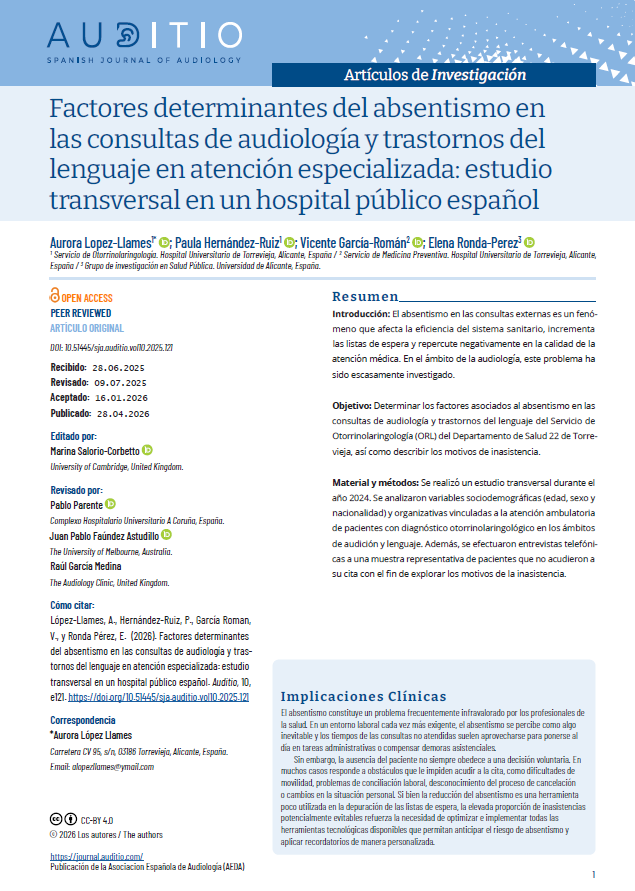
Introduction. Non-attendance at medical appointments is a phenomenon that affects the efficiency of the healthcare system, increases waiting lists, and negatively impacts the quality of medical care.
In the field of audiology, this issue has been scarcely investigated.
Objective. To analyze the profile of patients who miss their audiology and language disorder appointments at the Otorhinolaryngology (ENT) Department of Health Area 22 in Torrevieja, and to explore the reasons for their non-attendance.
Materials and Methods. A cross-sectional study was conducted during 2024. Sociodemographic and organizational variables were analyzed in patients with ENT-related diagnoses involving hearing and language disorders. Telephone interviews were conducted with a representative sample of patients who did not attend their appointments to explore the reasons for non-attendance.
Results. The non-attendance rate for audiology consultations was 8.9%. Factors significantly associated with non-attendance included age under 65 years, being born outside of Spain, and follow-up (as opposed to first-time) appointments. A total of 41% of reported reasons for non-attendance were potentially avoidable, the most common being forgetfulness, administrative errors, and failures in communication with the healthcare system.
Conclusions. Non-attendance in audiology is influenced by sociodemographic and organizational factors. Identifying risk profiles and understanding the real reasons for non-attendance would allow the design of targeted strategies to improve healthcare system accessibility and efficiency.
Downloads
Visibility and Altmetrics
Metrics
Global Statistics ℹ️
|
1897
Views
|
1594
Downloads
|
|
3491
Total
|
|
References
Adkins, D., Rojas-Ramirez, M. V., Shanker, A., Burruss, C. P., Mirsky, B., Westgate, P., Shinn, J. B., & Bush, M. L. (2023). Factors Associated with No-Show Rates in a Pediatric Audiology Clinic. Otology & Neurotology: Official Publication of the American Otological Society, American Neurotology Society [and] European Academy of Otology and Neurotology, 44(9), e648–e652. https://doi.org/10.1097/MAO.0000000000003997
Alturbag, M. (2024). Factors and Reasons Associated With Appointment Non-attendance in Hospitals: A Narrative Review. Cureus, 16(4). https://doi.org/10.7759/cureus.58594
Ansell, D., Crispo, J. A. G., Simard, B., & Bjerre, L. M. (2017). Interventions to reduce wait times for primary care appointments: A systematic review. BMC Health Services Research, 17(1), 295. https://doi.org/10.1186/s12913-017-2219-y
Baptista, S. C. P. D., Juliani, C. M. C. M., Lima, S. G. S. E., Martin, L. B., Silva, K. A. B. da, & Cirne, M. R. (2021). Patient absenteeism in outpatient consultations: An integrative literature review. Revista Da Escola De Enfermagem Da USP, 55, e20200380. https://doi.org/10.1590/1980-220X-REEUSP-2020-0380
Brewster, S., Bartholomew, J., Holt, R. I. G., & Price, H. (2020). Non-attendance at diabetes outpatient appointments: A systematic review. Diabetic Medicine: A Journal of the British Diabetic Association, 37(9), 1427–1442. https://doi.org/10.1111/dme.14241
Burgos, R. (2024, 18 de agosto). Cómo la población se cuadruplica en Torrevieja: Doble de basura y supermercados sin existencias. El País. https://elpais.com/economia/2024-08-18/como-la-poblacion-se-cuadruplica-en-torrevieja-doble-de-basura-y-supermercados-sin-existencias.html
Carreras-García, D., Delgado-Gómez, D., Llorente-Fernández, F., & Arribas-Gil, A. (2020). Patient No-Show Prediction: A Systematic Literature Review. Entropy, 22(6), 675. https://doi.org/10.3390/e22060675
Claveau, J., Authier, M., Rodrigues, I., & Crevier-Tousignant, M. (2020). Patients’ missed appointments in academic family practices in Quebec. Canadian Family Physician, 66(5), 349–355.
Cohen, A. D., Kaplan, D. M., Shapiro, J., Levi, I., & Vardy, D. A. (2005). Health Provider Determinants of Nonattendance in Pediatric Otolaryngology Patients.. The Laryngoscope, 115, 1804–1808. https://doi.org/10.1097/01.mlg.0000175202.50499.63
Cohen, A. D., Kaplan, D. M., Kraus, M., Rubinshtein, E., & Vardy, D. A. (2007). Nonattendance of adult otolaryngology patients for scheduled appointments. The Journal of Laryngology and Otology, 121(3), 258–261. https://doi.org/10.1017/S0022215106003653
Comité de Derechos Económicos, S. Y. C. (2000). Observación General Nº 14 (2000): El derecho al disfrute del más alto nivel posible de salud (artículo 12 del Pacto Internacional de Derechos Económicos, Sociales y Culturales). Refworld. https://www.refworld.org/es/leg/coment/cescr/2000/es/36991
Dantas, L. F., Fleck, J. L., Cyrino Oliveira, F. L., & Hamacher, S. (2018). No-shows in appointment scheduling―a systematic literature review. Health Policy, 122(4), 412–421. https://doi.org/10.1016/j.healthpol.2018.02.002
Fiorillo, C. E., Hughes, A. L., I-Chen, C., Westgate, P. M., Gal, T. J., Bush, M. L., & Comer, B. T. (2018). Factors associated with patient no-show rates in an academic otolaryngology practice. The Laryngoscope, 128(3), 626–631. https://doi.org/10.1002/lary.26816
Fitzpatrick, J. H., Willard, A., Edwards, J. R., Harhay, M. N., Schinasi, L. H., Matthews, J., & May, N. (2024). Time Series Analysis: Associations Between Temperature and Primary Care Utilization in Philadelphia, Pennsylvania. American Journal of Preventive Medicine, 67(5), 658–665. https://doi.org/10.1016/j.amepre.2024.06.014
Fonseca, E., Vázquez, P., Mata, P., Pita, S., & Luisa Muiño, M. (2001). Estudio de la inasistencia a las citaciones en consulta en un servicio de dermatología. Piel, 16(10), 485–489. https://doi.org/10.1016/S0213-9251(01)72509-9
Hernández-García, I., Chaure-Pardos, A., Moliner-Lahoz, J., Prieto-Andrés, P., Mareca-Doñate, R., Giménez-Júlvez, T., López-Mendoza, H., García-Montero, J. I., & Aibar-Remón, C. (2018). Absentismo, y factores asociados, en las citas programadas de una consulta externa de Medicina Preventiva. Journal of Healthcare Quality Research, 33(2), 82–87. https://doi.org/10.1016/j.cali.2017.12.006
Husman, T., Miraftab-Salo, O., Ilan, A., Brodie, S., Paciorek, A., Durr, M. L., Chang, J., & Xu, M. J. (2025). Predictors of No-Show in a Safety-Net Otolaryngology Clinic: A Repeated Measures Approach. The Laryngoscope. https://doi.org/10.1002/lary.32150
Jacobs, E. A., Shepard, D. S., Suaya, J. A., & Stone, E.-L. (2004). Overcoming language barriers in health care: Costs and benefits of interpreter services. American Journal of Public Health, 94(5), 866–869. https://doi.org/10.2105/ajph.94.5.866
Kaplan-Lewis, E., & Percac-Lima, S. (2013). No-Show to Primary Care Appointments: Why Patients Do Not Come. Journal of Primary Care & Community Health, 4(4), 251–255. https://doi.org/10.1177/2150131913498513
Kheirkhah, P., Feng, Q., Travis, L. M., Tavakoli-Tabasi, S., & Sharafkhaneh, A. (2016). Prevalence, predictors and economic consequences of no-shows. BMC Health Services Research, 16, 13. https://doi.org/10.1186/s12913-015-1243-z
Lehmann, T. N. O., Aebi, A., Lehmann, D., Balandraux Olivet, M., & Stalder, H. (2007). Missed appointments at a Swiss university outpatient clinic. Public Health, 121(10), 790–799. https://doi.org/10.1016/j.puhe.2007.01.007
Mahmood, S., Jalal, Z., Hadi, M. A., & Shah, K. U. (2020). Association between attendance at outpatient follow-up appointments and blood pressure control among patients with hypertension. BMC Cardiovascular Disorders, 20(1), 458. https://doi.org/10.1186/s12872-020-01741-5
McQueenie, R., Ellis, D. A., McConnachie, A., Wilson, P., & Williamson, A. E. (2019). Morbidity, mortality and missed appointments in healthcare: A national retrospective data linkage study. BMC Medicine, 17(1), 2. https://doi.org/10.1186/s12916-018-1234-0
Mesa, M. L. J., Asencio, J. M. M., & Ruiz, F. R. (2015). Factores determinantes y coste económico del absentismo de pacientes en consultas externas de la Agencia Sanitaria Costa del Sol. An. Sist. Sanit. Navar., 38.
Miller, A. J., Chae, E., Peterson, E., & Ko, A. B. (2015). Predictors of repeated «no-showing» to clinic appointments. American Journal of Otolaryngology, 36(3), 411–414. https://doi.org/10.1016/j.amjoto.2015.01.017
Ministerio de Sanidad (s. f.). Indicadores clave del Sistema Nacional de Salud. Recuperado 8 de noviembre de 2025, de https://inclasns.sanidad.gob.es/
Morera Guitart, J., Mas Server, M. À., & Mas Sesé, G. (2002). Análisis de los pacientes no presentados a la consulta de neurología de La Marina Alta. Revista de Neurología, 34(08), 701. https://doi.org/10.33588/rn.3408.2001473
Neal, R. D., Hussain-Gambles, M., Allgar, V. L., Lawlor, D. A., & Dempsey, O. (2005). Reasons for and consequences of missed appointments in general practice in the UK: Questionnaire survey and prospective review of medical records. BMC Family Practice, 6, 47. https://doi.org/10.1186/1471-2296-6-47
Negro Álvarez, J. M., Guerrero Fernández, M., Campuzano López, F. J., Bernal Fernández, T., Pellicer, F., Murcia Vivancos, M. C., & Ferrándiz Gomis, R. (2002). Incumplimiento a citas concertadas en pacientes de una consulta de alergología. Alergol. inmunol. clín. (Ed. impr.), 295–302.
Rodríguez Alcalá, F. J., Chacón Fuertes, J., Esteban Tudela, M., Valles Fernández, N., López de Castro, F., & Sánchez Ramiro, A. (2005). Motivos de interconsulta entre atención primaria y el segundo nivel. Atención Primaria, 36(3), 137–143. https://doi.org/10.1157/13077482
Shaw, T., Metras, J., Ting, Z. A. L., Courtney, E., Li, S.-T., & Ngeow, J. (2018). Impact of Appointment Waiting Time on Attendance Rates at a Clinical Cancer Genetics Service. Journal of Genetic Counseling, 27(6), 1473–1481. https://doi.org/10.1007/s10897-018-0259-z
Wick, A., & Koller, M. T. (2005). Views of patients and physicians on follow-up visits: Results from a cross-sectional study in Swiss primary care. Swiss Medical Weekly, 135(9–10), 139–144. https://doi.org/10.4414/smw.2005.10871
Wilson, C. A., Jamil, T. L., Velu, P. S., & Levi, J. R. (2024). Patient Factors Associated with Missed Otolaryngology Appointments at an Urban Safety-Net Hospital. The Laryngoscope, 134(9), 4003–4010. https://doi.org/10.1002/lary.31401
World Health Organization. (1946). Constitution of the World Health Organization. https://www.who.int/about/governance/constitution
Zirkle, M. S., & McNelles, L. R. (2011). Nonattendance at a Hospital-Based Otolaryngology Clinic: A Preliminary Analysis within a Universal Healthcare System. Ear, Nose & Throat Journal, 90(8), E32–E34. https://doi.org/10.1177/014556131109000822
Downloads
Published
How to Cite
License
Copyright (c) 2026 Aurora López-Llames, Paula Hernández-Ruiz, Vicente García-Roman, Elena Ronda-Pérez

This work is licensed under a Creative Commons Attribution 4.0 International License.
All articles will be published under the open Creative Commons Attribution (CC-BY) license. This license allows others to share and adapt the content, even for commercial purposes, as long as appropriate credit is given to the authors and the journal. By submitting their manuscript, authors retain copyright but grant the journal the right to make the first publication under this license.
More information about this license is available at: https://creativecommons.org/licenses/by/4.0/
Articles published between 2001 and 2020
The texts published in this journal in the section "AUDITIO 2001-2020" are subject - unless otherwise indicated - to a Creative Commons Attribution 3.0 Spain license. You can copy, distribute, communicate them publicly, make derivative works and commercial uses provided that you acknowledge the credits of the works (authorship, name of the journal, publishing institution) in the manner specified by the authors or by the journal. The full license can be consulted at http://creativecommons.org/licenses/by/3.0/es/deed.es.