
Adaptación transcultural de la versión en español del cuestionario Speech, Spatial and Qualities of Hearing Scale para padres (ES-SSQ-p) en formato en línea
DOI:
https://doi.org/10.51445/sja.auditio.vol10.2026.116Keywords:
SSQp, cuestionario, discapacidad auditiva, hipoacusiaAbstract
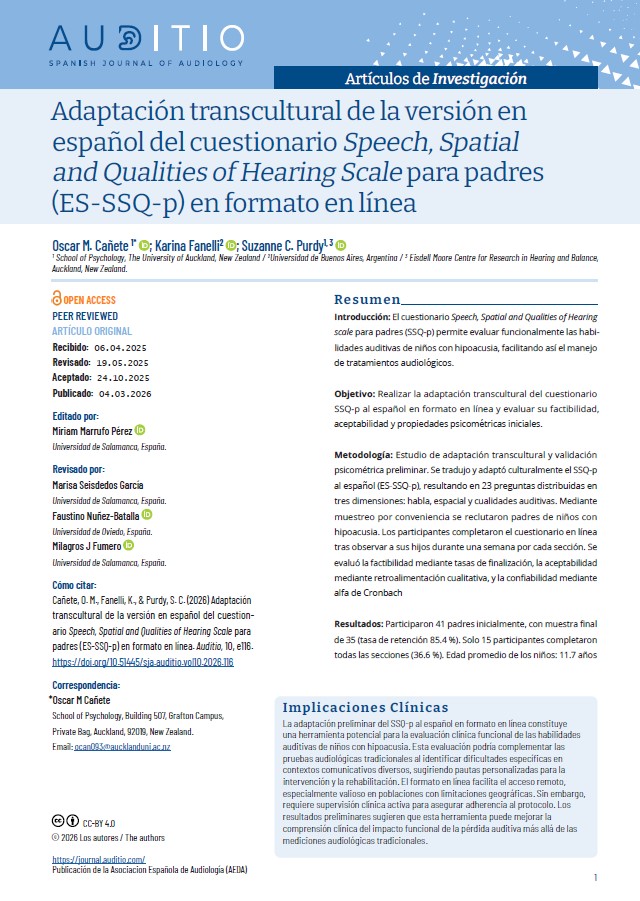
Introducción: El cuestionario Speech, Spatial and Qualities of Hearing scale para padres (SSQ-p) permite evaluar funcionalmente las habilidades auditivas de niños con hipoacusia, facilitando así el manejo de tratamientos audiológicos.
Objetivo: Realizar la adaptación transcultural del cuestionario SSQ-p al español en formato en línea y evaluar su factibilidad, aceptabilidad y propiedades psicométricas iniciales.
Metodología: Estudio de adaptación transcultural y validación psicométrica preliminar. Se tradujo y adaptó culturalmente el SSQ-p al español (ES-SSQ-p), resultando en 23 preguntas distribuidas en tres dimensiones: habla, espacial y cualidades auditivas. Mediante muestreo por conveniencia se reclutaron padres de niños con hipoacusia. Los participantes completaron el cuestionario en línea tras observar a sus hijos durante una semana por cada sección. Se evaluó la factibilidad mediante tasas de finalización, la aceptabilidad mediante retroalimentación cualitativa, y la confiabilidad mediante alfa de Cronbach
Resultados: Participaron 41 padres inicialmente, con muestra final de 35 (tasa de retención 85.4 %). Solo 15 participantes completaron todas las secciones (36.6 %). Edad promedio de los niños: 11.7 años (DE = 3.8). El ES-SSQ-p demostró excelente consistencia interna (α = 0.94; IC 95 %: 0.89-0.98). Se observó pérdida progresiva de datos del 2.9 % al 37.1 %, siendo la sección "cualidades" la más afectada. Los padres no reportaron dificultades significativas de comprensión del cuestionario.
Conclusiones: Este estudio preliminar de adaptación transcultural demostró que el ES-SSQ-p presenta alta confiabilidad y buena comprensibilidad, sugiriendo su potencial utilidad clínica. Sin embargo, la pérdida progresiva de datos requiere optimización del formato en línea. Se necesitan estudios con muestras mayores para completar la validación psicométrica antes de la implementación clínica.
Downloads
Visibility and Altmetrics
Metrics
Global Statistics ℹ️
|
2408
Views
|
1747
Downloads
|
|
4155
Total
|
|
References
Bagatto, M., Scollie, S. D., Hyde, M., y Seewald, R. (2010). Protocol for the provision of amplification within the Ontario Infant hearing program. International Journal of Audiology, 49(SUPPL. 1). https://doi.org/10.3109/14992020903080751 DOI: https://doi.org/10.3109/14992020903080751
Beaton, D. E., Bombardier, C., Guillemin, F., y Ferraz, M. B. (2000). Guidelines for the process of cross-cultural adaptation of self-report measures. Spine, 25(24), 3186–3191. https://doi.org/10.1097/00007632-200012150-00014 DOI: https://doi.org/10.1097/00007632-200012150-00014
Bieńkowska, K. I., y Zyśk, E. (2024). Parents and Teachers in the Process of Functional Assessment—On the Example of Adaptive Skills of Children and Adolescents with Hearing Impairment. Lublin Pedagogical Journal, 43(2), 89–108. https://doi.org/10.17951/lrp.2024.43.2.89-108 DOI: https://doi.org/10.17951/lrp.2024.43.2.89-108
Bishop, D. V. M., y Baird, G. (2001). Parent and teacher report of pragmatic aspects of communication: Use of the Children’s Communication Checklist in a clinical setting. Developmental Medicine and Child Neurology, 43(12), 809. https://doi.org/10.1017/S0012162201001475 DOI: https://doi.org/10.1017/S0012162201001475
Bonett, D. G. (2002). Sample Size Requirements for Testing and Estimating Coefficient Alpha. Journal of Educational and Behavioral Statistics, 27(4), 335–340. https://doi.org/10.3102/10769986027004335 DOI: https://doi.org/10.3102/10769986027004335
Bowling, A. (2005). Mode of questionnaire administration can have serious effects on data quality. Journal of Public Health, 27(3), 281–291. https://doi.org/10.1093/pubmed/fdi031 DOI: https://doi.org/10.1093/pubmed/fdi031
Cañete, O. M., Purdy, S. C., Brown, C. R. S., Neeff, M., y Thorne, P. R. (2020). Behavioural performance and self-report measures in children with unilateral hearing loss due to congenital aural atresia. Auris Nasus Larynx,48(1), 6574. https://doi.org/10.1016/j.anl.2020.07.008 DOI: https://doi.org/10.1016/j.anl.2020.07.008
Falzone, C., Guerzoni, L., Pizzol, E., Fabrizi, E., y Cuda, D. (2022). An Adaptation and Validation Study of the Speech, Spatial, and Qualities of Hearing Scale (SSQ) in Italian Normal-Hearing Children. Audiology research, 12(3), 297–306. https://doi.org/10.3390/AUDIOLRES12030031 DOI: https://doi.org/10.3390/audiolres12030031
Fang, T.-Y., Lin, P.-H., Ko, Y., Wu, C.-C., Wang, H., Liao, W.-C., y Wang, P.-C. (2024). Validation of the Chinese Version of the Speech, Spatial, and Qualities of Hearing Scale for Parents and Children. Ear & Hearing,45(6), 13621368 https://doi.org/10.1097/AUD.0000000000001525 DOI: https://doi.org/10.1097/AUD.0000000000001525
Galvin, K. L., y Mok, M. (2016). Everyday Listening Performance of Children Before and After Receiving a Second Cochlear Implant: Results Using the Parent Version of the Speech, Spatial, and Qualities of Hearing Scale. Ear & Hearing, 37(1), 93–102. https://doi.org/10.1097/AUD.0000000000000226 DOI: https://doi.org/10.1097/AUD.0000000000000226
Galvin, K. L., y Noble, W. (2013). Adaptation of the speech, spatial, and qualities of hearing scale for use with children, parents, and teachers. Cochlear Implants International, 14(3), 135–141. https://doi.org/10.1179/1754762812Y.0000000014 DOI: https://doi.org/10.1179/1754762812Y.0000000014
Galvin, K. L., Sarant, J. Z., Harris, D. C., Bennet, L. A., Mok, M., y Canagasabey, M. (2015). Performance ratings for children using bilateral cochlear implants obtained with the Speech, Spatial, and Other Qualities of Hearing Scale for parents. Cochlear Implants International, 16(sup1), S19–S22. https://doi.org/10.1179/1467010014Z.000000000227 DOI: https://doi.org/10.1179/1467010014Z.000000000227
Gargula, S., Simon, F., Célérier, C., Couloigner, V., Leboulanger, N., Loundon, N., y Denoyelle, F. (2022). French adaptation and validation of the Speech, Spatial and Qualities of Hearing scale for Parents (SSQ-P) and for Children (SSQ-Ch). International journal of audiology, 62(8), 738–746. https://doi.org/10.1080/14992027.2022.2084461 DOI: https://doi.org/10.1080/14992027.2022.2084461
Gatehouse, S., y Noble, W. (2004). The Speech, Spatial and Qualities of Hearing Scale (SSQ). International Journal of Audiology, 43(2), 85–99. https://doi.org/10.1080/14992020400050014 DOI: https://doi.org/10.1080/14992020400050014
Hall, D. A., Zaragoza Domingo, S., Hamdache, L. Z., Manchaiah, V., Thammaiah, S., Evans, C., y Wong, L. L. N. (2018). A good practice guide for translating and adapting hearing-related questionnaires for different languages and cultures. International Journal of Audiology, 57(3), 161–175. https://doi.org/10.1080/14992027.2017.1393565 DOI: https://doi.org/10.1080/14992027.2017.1393565
Killan, C. F., Baxter, P. D., y Killan, E. C. (2020). Face and content validity analysis of the Speech, Spatial and Qualities of Hearing Scale for Parents (SSQ-P) when used in a clinical service without interviews or week-long observation periods. International journal of pediatric otorhinolaryngology, 133. https://doi.org/10.1016/J.IJPORL.2020.109964 DOI: https://doi.org/10.1016/j.ijporl.2020.109964
Kim, H. J., Lee, H. J., An, S. Y., Sim, S., Park, B., Kim, S. W., Lee, J. S., Hong, S. K., y Choi, H. G. (2015). Analysis of the Prevalence and Associated Risk Factors of Tinnitus in Adults. PLOS ONE, 10(5), e0127578. https://doi.org/10.1371/JOURNAL.PONE.0127578 DOI: https://doi.org/10.1371/journal.pone.0127578
King, A. M. (2010). The national protocol for paediatric amplification in Australia. International Journal of Audiology, 49(SUPPL. 1). https://doi.org/10.3109/14992020903329422 DOI: https://doi.org/10.3109/14992020903329422
Maggio De Maggi, M. (2004). Terapia Auditivo Verbal. Enseñar a escuchar para aprender a hablar. Auditio, 2(3), 64–73. https://doi.org/10.51445/sja.auditio.vol2.2004.0029 DOI: https://doi.org/10.51445/sja.auditio.vol2.2004.0029
McCreery, R. W., Walker, E. A., Spratford, M., Oleson, J., Bentler, R., Holte, L., y Roush, P. (2015). Speech recognition and parent-ratings from auditory development questionnaires in children who are hard of hearing. Ear and hearing, 36, 60S-75S. https://doi.org/10.1097/AUD.0000000000000213 DOI: https://doi.org/10.1097/AUD.0000000000000213
Ministerio de Salud de Chile (2013). Guía Clínica AUGE: Hipoacusia Bilateral En Personas de 65 Años y Más Que Requieren Uso de Audífonos. https://diprece.minsal.cl/programas-de-salud/guias-clinicas/
Noble W. (2012). Cuestionario sobre el lenguaje, la audición espacial y las cualidades auditivas—Visita inicial—Cochlear IROS. https://www.ihr.mrc.ac.uk/
Noble, W., y Gatehouse, S. (2006). Effects of bilateral versus unilateral hearing aid fitting on abilities measured by the Speech, Spatial, and Qualities of Hearing scale (SSQ). International Journal of Audiology, 45(3), 172–181. DOI: https://doi.org/10.1080/14992020500376933
Swanepoel, D. W., Clark, J. L., Koekemoer, D., Hall Iii, J. W., Krumm, M., Ferrari, D. V., McPherson, B., Olusanya, B. O., Mars, M., Russo, I., y Barajas, J. J. (2010). Telehealth in audiology: The need and potential to reach underserved communities. International Journal of Audiology, 49(3), 195–202. https://doi.org/10.3109/14992020903470783 DOI: https://doi.org/10.3109/14992020903470783
Terwee, C. B., Bot, S. D. M., de Boer, M. R., van der Windt, D. A. W. M., Knol, D. L., Dekker, J., Bouter, L. M., y de Vet, H. C. W. (2007). Quality criteria were proposed for measurement properties of health status questionnaires. Journal of Clinical Epidemiology, 60(1), 34–42. https://doi.org/10.1016/j.jclinepi.2006.03.012 DOI: https://doi.org/10.1016/j.jclinepi.2006.03.012
Tharpe, A. M. (2004). Who has time for functional auditory assessments? We all do! Volta Voices, 11(7), 10–12.
Thorén, E. S., Andersson, G., y Lunner, T. (2012). The use of research questionnaires with hearing impaired adults: Online vs. Paper-and-pencil administration. BMC Ear, Nose and Throat Disorders, 12(1), 12. https://doi.org/10.1186/1472-6815-12-12 DOI: https://doi.org/10.1186/1472-6815-12-12
Valente, M., Abrams, H., Benson, D., Chisolm, T., Citron, D., Hampton, D., Loavenbruck, A., Ricketts, T., Solodar, H., y Sweetow, R. (2006). Guidelines for the Audiologic Management of Adult Hearing Impairment Task Force Members. The American Academy of Audiology: Reston, VA, USA. https://www.audiology.org/practice-guideline/guidelines-for-the-audiologic-management-of-adult-hearing-impairment/
Downloads
Published
How to Cite
License
Copyright (c) 2026 Oscar M. Cañete, Karina Fanelli, Suzanne C Purdy

This work is licensed under a Creative Commons Attribution 4.0 International License.
All articles will be published under the open Creative Commons Attribution (CC-BY) license. This license allows others to share and adapt the content, even for commercial purposes, as long as appropriate credit is given to the authors and the journal. By submitting their manuscript, authors retain copyright but grant the journal the right to make the first publication under this license.
More information about this license is available at: https://creativecommons.org/licenses/by/4.0/
Articles published between 2001 and 2020
The texts published in this journal in the section "AUDITIO 2001-2020" are subject - unless otherwise indicated - to a Creative Commons Attribution 3.0 Spain license. You can copy, distribute, communicate them publicly, make derivative works and commercial uses provided that you acknowledge the credits of the works (authorship, name of the journal, publishing institution) in the manner specified by the authors or by the journal. The full license can be consulted at http://creativecommons.org/licenses/by/3.0/es/deed.es.